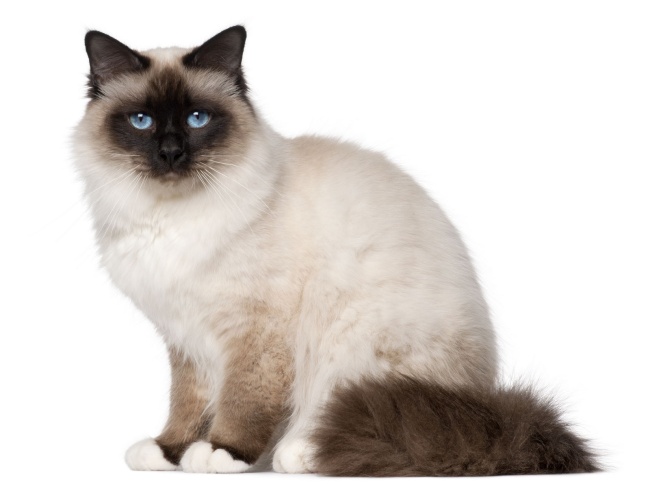
The Burmese cat (Birman), or sacred Burmese, is elegance itself. The characteristic feature of its colouring is the colouring of its paws: the front white "toes" are shorter and the back ones are higher. Burmese cats are obedient and intelligent. They like to play and run with the owner, but they are also able to spend time alone.
History of the breed
Burma (now the Republic of the Union of Myanmar), a small country located in the western part of the Indochina peninsula, is considered to be the homeland of this cat. The Burmese cat was the result of crossing Siamese and Persian cats. Burmese cats first appeared in Europe in 1919. It is believed that they were presented to a French traveller by Buddhist monks of Burma. The Burma was recognised as an independent breed in France in 1925.
Initially, only two colours were recognised: dark brown (sil-point) and blue (blue-point), which are still considered traditional.
In the 1960s other colours began to appear: chocolate, red, cream and their combinations - tabby and tortie, i.e. striped and tortoiseshell.
Care
Like other long-haired cats, representatives of the Burmese breed need careful care. The pet needs to be brushed regularly to avoid the formation of hairballs. This is quite a healthy breed without predisposition to genetic diseases. Animals are not prone to obesity, do not need strict control of the diet.
Breeding
Burmese cat kittens are born almost white. The typical colour starts to appear in the first few days, and this process develops until two years of age. The colour of the "toes" becomes distinguishable at 16 weeks, but their quality can be judged only after a couple of months. White spots in the toe area are considered to be a defect in the breed.