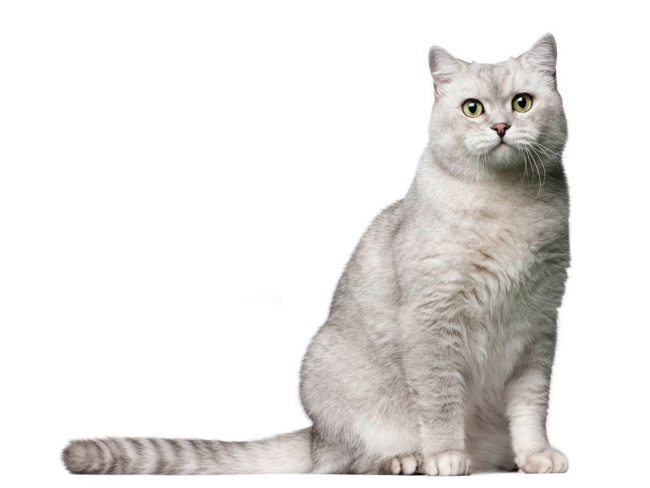
Outwardly Burmilla looks like a Burmese cat, but with an unusual chinchilla color.
The Burmilla is a medium-sized short-haired cat. Its weight ranges from 2 to 7kg. Burmilla is independent, easily tolerates loneliness and will always find something to do. It is affectionate, strongly attached to the owner, calm, gets along with all members of the family and is very patient with small children.
History of the breed
The breed originated in 1981 in Great Britain. Baroness Miranda von Kirchberg had a purple-coloured Bur-Man cat and a chinchilla Persian. A servant miscarried and the accidental union resulted in short-haired kittens of unusual colour. In 1984, the first breed club was established in the UK. In 1989 it was recognised by the British Cat Fanciers' Organisation (GCCF) and in 1994 by the International Federation of Cats (FIFe).
Externally, the Burmilla resembles a Burmese cat, but with an unusual chinchilla colour. This shade is due to the type-ping: the lower part of the coat is depigmented, and the tip has a dark colour.
Care
This is not the most demanding breed in terms of care and maintenance. The animal's coat is somewhat longer than that of ordinary short-haired cats. It is necessary to comb it out once a week and bathe the pet as needed. Burmills have excellent health, and with proper care, they rarely get sick. No hereditary diseases have been identified.
Breeding
Defects of the breed: weak chin, eye colour other than green (yellow shade is allowed only in young cats up to two years old, amber - only in tortoiseshell-coloured animals), excessively long or protruding hair, tabby marks on the limbs. With distinct tipping, the tips of the coat may be chocolate, cream, red, brown, mauve or blue in colour.
Careful selection of breeders is necessary to maintain the breed line at all times. Because of this, Burmillas are quite expensive.