
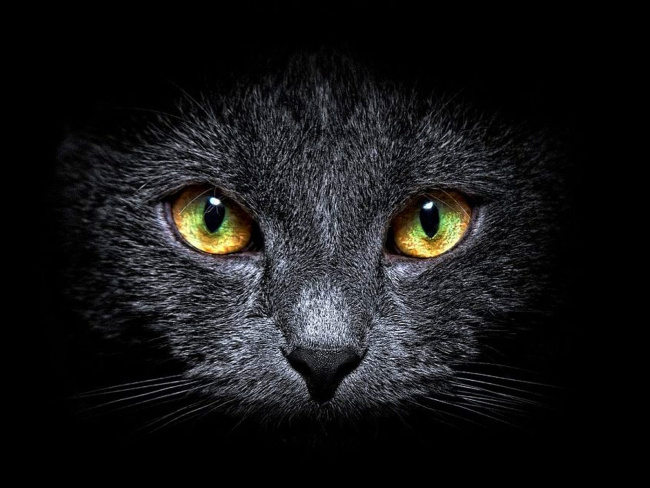
If there is no light at all, a cat will not be able to see anything simply because no light enters the eye to stimulate the nerve endings of the retina. Therefore, in complete darkness, cats have no advantage over other animals.
However, in dim light — sometimes so dim that the human eye perceives it as pitch darkness — cats are much better than us at navigating among objects, especially if they are moving. There are three main reasons for this phenomenon.
Three reasons why cats see better than us in the dark.
Firstly, there are two types of nerve endings in the retina, which are called rods and cones depending on their shape. Cones react intensely to bright light and are responsible for color vision and the perception of fine details.
Rods react to low-intensity light and are unable to reproduce sharp images. The twilight vision of all animals is due to the functioning of rods. The ratio of rods to cones in a cat's eye is approximately 25:1, while in humans it is 4:1.
Secondly, cats, along with many other domestic animals, but unlike humans, have a reflective layer located directly behind the retina. Its function is to reflect light rays that enter the eye and irritate the nerve endings back onto those same nerve endings. Consequently, each ray of light affects the nerve ending twice, enhancing perception.
This explains the “cat's eye” effect that occurs when a ray of light is directed from the darkness directly into the eyes. The light is reflected from the greenish-yellow layer, creating the impression that in the dark the eyes glow yellow or green.
Thirdly, in all animals, the pupil of the eye dilates in twilight and constricts in bright light to keep the amount of light entering the eye at a constant level — the level at which the eye functions best.
A cat's pupil can dilate significantly. In bright light, it becomes a vertical slit, but in dim light, it becomes round and can reach almost a centimeter in diameter. This ability of the pupil allows more light to enter the eye and stimulate the rods.
The combination of these three factors means that in very low light, cats receive significantly more visual information than humans. Cats can distinguish objects and other animals in light that is less than 20% of the amount of light required by the human eye!