The language of the tail.
• The tail slowly bends down and then rises again. This means that the cat is relaxed and completely content with its surroundings.
• The tail rises slightly and curls gently. This means that the cat is interested in something.
• The tail is stretched straight, but the tip is slightly bent. This means that the cat is very interested in something and is generally in a friendly mood, but with some reservations.
• The tail is completely straight, and the tip is pointing strictly vertically. This is a sign of a sincere greeting without any reservations. Adult cats have borrowed this tail position from kittens, who greet their mother in this way. For kittens, this signal serves as a kind of invitation for their mother to check the condition of their rear passage. This gesture has an element of subordination, as, indeed, do most polite greeting ceremonies.
• The tail is completely lowered and may even be tucked between the hind legs. This means that the cat is defending itself or acknowledging the superiority of a stronger animal, emphasizing its social status.
•The tail is lowered and fluffed up. This means that the cat is quite frightened.
•The tail is moving furiously from side to side. This is a so-called conflict signal in its most ferocious expression. If the tail is lashing violently from side to side, it means that the animal is preparing to attack and is gathering its last drops of rage for this purpose.
•The tail is motionless, but its tip is trembling. This means that the cat is internally agitated. If the trembling of the tip becomes more noticeable, this may be evidence that the cat may move from a bad mood to decisive action with the help of its clawed paw.
• The tail is stretched out and trembles slightly along its entire length. This slight twitching can often be seen after the owner has greeted their cat. The same thing can be observed when a cat urinates outside its home, releasing pheromones. This gesture means, “Yes, it's me!” and serves as a kind of friendly calling card.
• The tail is shifted to one side. This is a signal of sexual “invitation” that the animal gives during heat. When a female is ready to meet a male, she shifts her tail to one side.
• The tail is fluffed up and held straight. This means that the cat is in an aggressive state.
• The tail is fluffed up and arched. This means that the cat is ready to defend itself, but may also attack if provoked further.
A few words about ears.
Ears are also noteworthy, as they convey mood and feelings.
• Twitching ears seem to say, “Yes, I see, I see, but I'm not interested.”
• Ears pointing forward, on the contrary, indicate clear interest or curiosity.
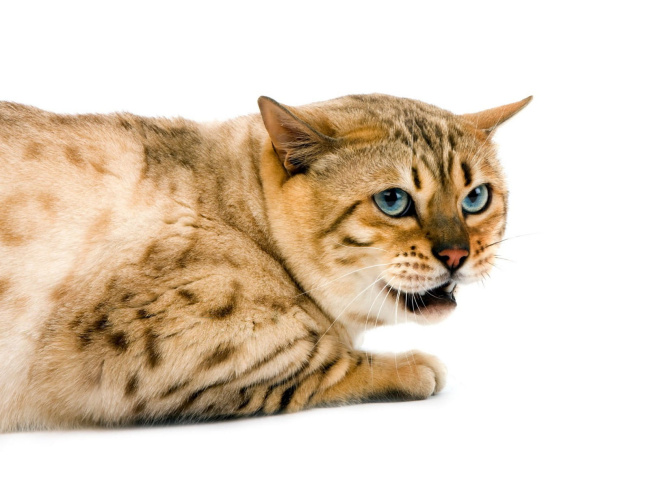
• Ears pulled back and pressed against the head are a sign of rage — the cat is ready to attack.
By the way
Half-closed eyes indicate a friendly disposition — it is a sign of trust and affection. You can use this yourself when talking to your cat. By covering your eyes, you will further strengthen your mutual love and friendship.
Licking the lips.
Another sign of some anxiety or interest, especially when the cat quickly licks its lips exactly twice while looking warily at a person or object that is bothering it.
Other types of lip licking — for example, after a cat has eaten — are more pronounced and should not be confused with the sign of anxiety described above.
Prolonged lip licking can also indicate that the cat is nauseous.
Welcome dance.
A greeting signal that cats give when they approach someone they love. They lift their two front paws off the ground and quickly put them back down, keeping their paws completely straight and tense. After that, the cat will often rub against the legs of the person it has greeted in this way.
Head bobbing.
Another greeting signal, almost exclusively used with other cats. The head is quickly tilted forward and backward and may turn slightly from side to side.
Raising a relaxed paw.
Sometimes you may notice a cat suddenly stop and raise one front paw, while relaxing the lower part of it so that it hangs loosely. After that, the animal's entire appearance suggests that it is completely focused on something, such as a smell. This signal indicates that something unexpected or puzzling has caught the cat's attention and it is trying to determine what it is, while trying not to betray its interest with awkward movements. This is roughly equivalent to our “What the hell is that?!”
Showing the belly.
When this action is directed at a person or other cats, it is an unmistakable sign of friendship and trust. Usually, in any situation, a cat aggressively protects its belly — you will quickly discover this when you try to touch it without the cat's permission. The response to such familiarity will be a scratch and a bite. This is not a sign of anger, but merely an instinctive reflex left over from ancient times when wild cats protected the most vulnerable part of their bodies.
If you and your cat trust each other completely and unconditionally, it will expose its belly to you. When inviting you to pet it, the cat will roll onto its back, throw back its front paws, and let their pads hang down in a relaxed state. This means that you are invited to gently stroke its belly and even pat it lightly. But be careful and cautious if such an invitation comes from an unfamiliar cat (very often cats roll onto their backs to be scratched, as many animals do) — in response to your trust, it may extend its claws.
Facial expressions.
The great ethologist Konrad Lorenz wrote that “some animals demonstrate their mood through facial expressions, but none of them have mastered this art as well as cats.” Cats are unique: they are capable of displaying two completely opposite emotions — fear and aggression at the same time.
A cat can express irritation along with fear, ranging from very moderate to extremely intense. Similarly, a cat can show real terror, accompanied by complete submission and incredible aggression expressed on its face. This information allows us to assess and interpret the entire range of feline emotions.
When an animal feels almost no fear, its ears stick up, and when it is most frightened, they press against its head, with the tips curving upward. The ears look different when aggression increases: the curve disappears, and they press more tightly against the head. This indicates that the cat is ready to defend its territory, fight for possession of a female, protect its offspring, and so on.
Note also that the pupils of the eyes dilate in both fear and aggression, and their maximum dilation is observed when both emotions merge into one very powerful emotion. This is also reflected in the cat's posture.
Pupil dilation is an important signal in both cats and humans, but it is not necessarily related to attack or defense. It is easy to tell whether a cat is alert or how much it likes a toy or a tasty treat — all this can be seen by the size of its pupils. The larger they are, the more alert the cat is and the more interested it is in your offer. If dilated eyes are combined with a lowered head, and the cat is staring intently at something (a person or another animal), it means that it is expressing a decisive threat, as if saying, “Don't mess with me, or else...”
How a cat purrs.
The sounds that make up an animal's “voice” (including that of a human) are produced by the vibration of the vocal cords in the larynx when air passes through them. The larynx is part of the respiratory tract through which air passes into and out of the lungs. As the vocal cords shorten due to increased tension, the pitch of the sound increases. This is how a cat's normal meow sounds.
However, the purring of various members of the cat family, including our domestic cats, consists of rapidly alternating sound pulses originating in the larynx. Each individual sound is caused by a sharp drop in air pressure after the separation of the right and left vocal cords. The muscles of the larynx are rapidly excited by nerve impulses at a frequency of twenty to thirty per second. At the same time, the vocal cords close and the air pressure increases. When the excitation of the muscles stops, the vocal cords diverge sharply, and the released air creates a sound.
An alternative theory of the mechanism of purring has been proposed. It suggests that purring is caused by an increase in the speed and turbulence of blood flow in the vein that returns blood from the rear of the body. The turbulence creates vibrations in the walls of this blood vessel where it passes through the chest, and these vibrations are then transmitted to the head through the air cavities. However, this hypothesis still needs further research.
By the way
The intensity of purring, its volume, depends on the degree of stimulation of the animal, for example, how it is petted or talked to. Often, even in the presence of a person, purring is quiet, barely audible, but if you put your finger on the cat's neck, you can feel the vibration of the larynx.