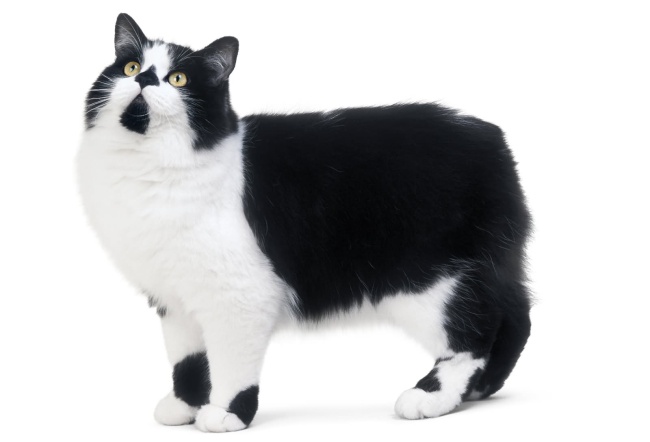
One of the oldest cat breeds, the Cymric is a long-haired variant of the Manx. Apart from their coat length, the Cymric and Manx are virtually identical - both have rounded features and naturally short tails. These slow-maturing breeds also share a playful, kitten-like personality that continues into adulthood. The Cymric and Manx are so genetically similar that Manx kittens can appear in Cymric litters and vice versa.
History of the breed
The kimrick's homeland is the Isle of Man, and its closest relatives are Manx cats. Along with short-haired offspring, Maine cats often gave birth to kittens with long "coats". However, until the 60s of the XX century such babies were considered plembrak and did not arouse the interest of specialists. The situation changed when the Maine tailless began to breed in Canada. Traditionally, Manxes there pleased breeders with heterogeneous litters. However, Canadian felinologists reacted to this phenomenon with joy and immediately started to breed a new breed.
There are many legends about the origin of simian cats. One of them says that in times immemorial, Welsh people used to shorten the tails of their pets so that they could get through the door faster and not cool down the poorly heat-retaining dwelling. According to another version, kimriks were very fond of stealing Vikings and the Irish, who considered their tails as a talisman bringing good luck, so mother cats began to bite off this part of the body to their babies.
Interestingly, the animals were christened Kimricks by the grandmother of one of the breed's first breeders, Blay Rush Welsh. The woman said that earlier she had seen tailless cats in Wales. This was followed by her suggestion to name them "cymric", which means "Welsh" in Welsh.
Although cymrics were announced and registered in the 1960s, they did not become popular in Canada and neighbouring USA until a decade later.
Care
In addition to a cot, scratching post, toys and food bowls, the kimrick should be provided with a sophisticated playground where he can entertain himself with exercise and all sorts of activities. Some individuals can be interested in a jogging wheel, so focus on your own cat's preferences.
If you live in a multi-storey building, take care of anti-cat nets. To fly out the window for a cousin of manxes is a matter of seconds. If you do not want to deprive the pet of the joy of watching what is happening outside, equip him with a special closed balcony. There are plenty of masterclasses on the web on how to make such a walking area.
The spectacular wool of the breed, unfortunately, has a peculiarity to pile up, so 1-2 times a week comb the pet. In the shedding season, you will have to do it at least every other day. Cats are bathed either on the eve of the show or as needed. A kimrick's coat can remain clean and presentable for years. Once a week, take time to inspect the ears. If you find wax in them, gently remove it with a cotton disc soaked in warm water or special hygienic lotion.
Wipe your pet's eyes daily with a clean cloth moistened with chamomile decoction or a special solution. For each eye use a separate cloth or cloth swab, so that in case of infection, not to spread it to both eyes. Once a week "Welsh" need to brush their teeth.
Choosing a Kitten
The most expensive "purchase" is considered to be a kimrick with a rampy tail (less often - rampy raiser), because this variety has more chances to get to the cat show. But if the price of the kitten worries more show career, choose creatures with a long-tail. They are usually cheaper.
When looking at adverts for sale kimriks look also for breeders offering long-haired manxes - this is the name under which the breed is "coded" in the CFA breeding lists.
Refuse to buy an animal that moves with a stiff, bouncing gait, as this is likely a symptom of a serious genetic disorder.