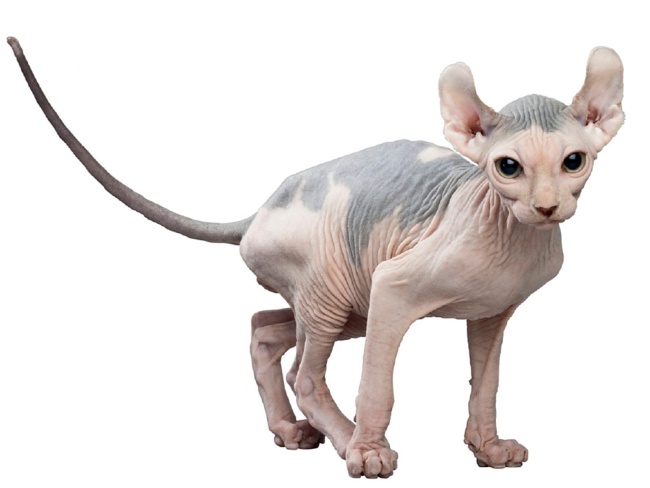
Quite recently, the breed of cats with the wonderful name Elf seemed to us as unattainably distant as its fairy-tale prototype. Today, anyone can get an elf, if, of course, is able to assess the character, personal qualities and appearance, is able to share the love and devotion of this magical creature.
History of the breed
At the end of the 20th century, breeders Karen Nielson and Kristen Leed decided to join forces to create a new breed that would combine the health and extraordinary curve of the Curlew's ears with the velvet skin of the Bald Sphynx. The breeders did not get their first tangible results until 2006. The elf, one of the most unusual and recognisable cat breeds, was born in the course of lengthy experiments. Already in 2007 the international felinological organisation TICA recognised this breed.
Care
Like all naked cats, Elves are sensitive to cold and draughts, so they need a warm house where they can hide if necessary. It is important to avoid draughts so that the cat does not catch a cold. The urge to bask under a hot lamp or the sun's rays can also be harmful to the cat - make sure that its skin does not dry out from excessive heat. Elf should be bathed regularly, using a hypoallergenic shampoo.
Genetic diseases peculiar to this young breed have not been identified to date. Breeders believe that elves have inherited their good health from curls.
Young elves are quite careful in games, and still it is important to make sure that the kittens, amusing themselves, did not scratch each other, because from teeth and claws, even released in a friendly fight, they are not protected by a woollen coat.
Breeding
In one litter, the cat breed elf brings from one to five kittens. Currently and in many countries there are catteries engaged in breeding elves.