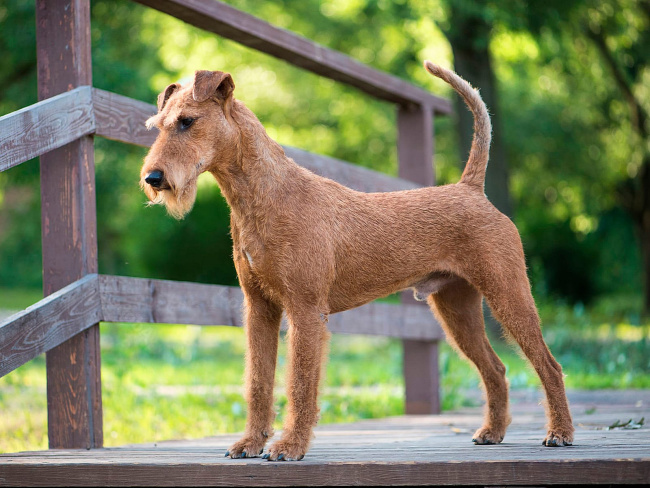
Irish terriers just love all kinds of pranks and active games.
The first mention of Irish terriers dates back to the middle of the 19th century. Some researchers believe that these dogs lived in Ireland much earlier than the famous patron saint of the country - St. Patrick.
Representatives of the breed are characterized by a sharp mind, fearless character and boundless loyalty. They are usually friendly dogs, although they never mind to get into a fight.
The breed was officially recognized in 1870, and Irish Terriers began to be specially bred in 1879. Small but brave dogs proved themselves during the First World War. Not afraid of the rumble of battle, they ran between the positions of the Allies to transmit messages.
Breed Popularity
Irish Terriers were first introduced at a dog show in 1875. From then on, their popularity began to grow.
In 1905, a magazine devoted entirely to Irish Terriers began publication. For some time it was published quarterly and had many subscribers.
Interest in representatives of this breed gradually increased, and then began to fade. One of the admirers of Irish terriers, Gordon Selfridge, even decided on a very unconventional marketing move. He arranged a monobreed show of his favorite dogs in one supermarket. Assistants in national Irish costumes told everyone about the breed and handed out brochures. At that time, there were more people interested in getting Irish terriers.
Game Lovers
This breed is often referred to as a “daredevil”, “cat terrier” or “red devil”. These definitions are quite appropriate. It is normal for Irish terriers to take something from the table with a paw, cat-like twisting it and releasing the claws. In addition, they are able to climb trees and fences. “Irish” just love all kinds of pranks and active games.
Health
Irish Terriers often have cracks and calluses on the pads of their feet, which are very difficult to get rid of. To avoid this, experts advise to regularly trim pets claws. In hot weather, cracked pads become sore, causing dogs to limp. If cracks have already appeared, rubbing petroleum jelly and olive oil can help. You can also regularly add a small amount of fish oil to the food.
Otherwise, this is a strong healthy dog, which well tolerates considerable physical exertion and severe weather conditions. “Irish” rarely suffer from obesity or allergies. They have very strong bones and almost never have joint problems. To the veterinarian, Irish terriers are mostly taken only for preventive procedures.
Character and Content
Irish Terrier owners especially appreciate the cheerfulness, courage and cheerful disposition of their pets. These dogs are always ready to stand up for themselves and protect the owner. Despite the fame of brawlers, Irish Terriers rarely attack first, but they are ready to fight to the last with the courage of a lion.
To children, dogs are friendly. They always do not mind to play and arrange joint pranks. At the same time, pets do not forget to patronize children and make sure that they do not get into trouble.
Irish terriers perfectly feel the mood of the owner. They know when a person is sad or happy, in which case you can, play with him or, conversely, leave the owner alone.
Representatives of the breed do not tolerate harsh treatment. If; the owner often shouts or shows indifference, they are closed in themselves. These dogs do not tolerate conflict, but they respond readily to affection, so it is much more effective to encourage them during training than to punish them.
By the way
It is very convenient to travel with Irish Terriers. They can travel well in a car or in the basket of a bicycle. They even like to sleep in the same sleeping bag with their owner, as long as they are taken on the next adventure.