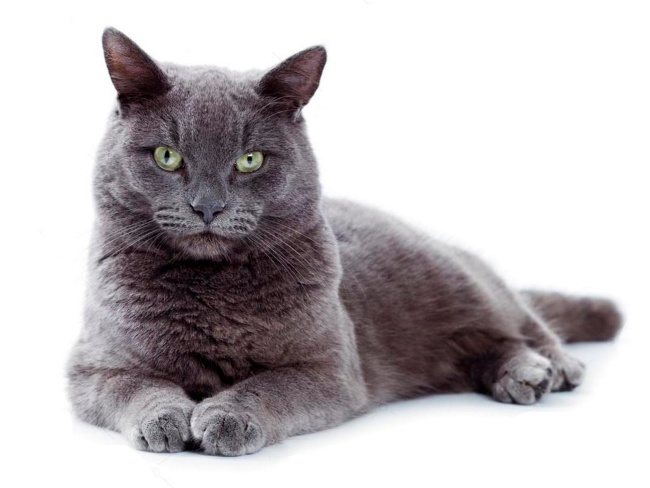
The intelligent, friendly, active Korat easily finds its way into the hearts of cat lovers. Their expressive green or amber eyes seem to look straight into the soul! The people of Thailand believe that this breed brings happiness, they are presented to honorable people, and a pair of Korats given to a bride promises a successful marriage.
History of the breed
The name of this aboriginal breed comes from the name of a highland plateau in Thailand. The first mention of the Korat breed is found in The Book of Cat Poems, a manuscript written between 1350 and 1767, where the breed was described as follows: "The coat is smooth, with an undercoat like the sky and tips of hair like silver; and the eyes shine like a dewdrop on a lotus leaf". The first show debut of the Korats at an exhibition in England in 1896 failed. Nevertheless, the breed's fame grew, and in 1959 the Korats made their way to the United States. In 1965 thanks to the efforts of enthusiasts the breed began to develop and soon it was recognized by all felinological organizations of the USA.
Care
Care for the coat of the Korat is not very difficult: it is enough to comb it out about once a week. Owners should pay attention to the fact that this breed is extremely susceptible to loud sounds. Any noise, especially unexpected, can disturb the mental balance of the cat, it can even make it sick.
Between the korat and its owner quickly establishes a strong bond, the rupture of which the cat experiences very hard. Korat, friendly and sociable with humans, in relation to cats of other breeds, other pets and even strangers can behave like a real domestic tyrant - he does not want to share his affection with someone else!
Breeding
The breeding of Korats is governed by strict rules. Only those individuals with ancestors from Thailand are considered purebred. Crossbreeding of Korats with other breeds is not allowed.
Their true eye color korats acquire by two to three years, before that they may have eyes shades of amber, and in the very early years of life. of amber, and in early childhood, gray-blue.