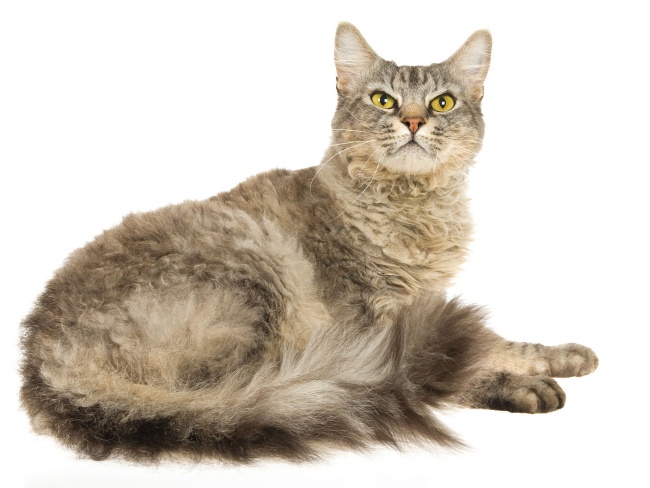
The breed's founder, Linda Coel, named these wonderful curly-haired creatures with a certain amount of irony. The fact is that perm in English means "curl", while the French article La refers not to European roots, but to the history of the Chinook Indians, who "for beauty" attached this article to every word. Laperm is an incredibly social cat, it loves affection, catches every glance of its owner and gets along well with other pets. But for a family with children Laperm is not suitable - the animal has an extremely sensitive scruff!
History of the breed
The history of the Laperm breed began on March 1, 1982, when on the farm of Linda and Richard Coel was born a kitten, almost completely devoid of cover, with strange stripes on the skin, similar to Indian tattoos. Gradually the little creature acquired a curly coat, and Linda named him Curly - Curly. Curly's kittens inherited the same unusual coat, and the owner decided to show them at a show. However, it took 10 years before the breed was recognized by specialists. A preliminary standard was adopted by the International Cat Association (TICA) in 1995.
The ringed and spiraled coat is the main distinguishing feature of the breed. On the chest and behind the ears it is curled into curls, and on the back it is messy curls
Care
Laperma wool does not require special care - curls well protect the skin from pollution and harmful influences. It is better to comb out the coat once every one or two weeks. Washing is recommended when dirty and before the show. Just before the show, the Laperma's coat is lightly sprayed with a sprayer to make the curls more distinct. This breed suffers greatly from flea infestation and may even develop an allergic reaction. It should be remembered that Lapermas have a sensitive scruff and should not be touched.
Laperm cats have no undercoat, which is the main cause of cat allergies. That is why they can be a real salvation for people who would like to have a companion animal, but did not dare to such a neighborhood because of allergic reactions.
Breeding
All colors are allowed. Until 2010, crossbreeding with domestic shorthair and longhair, preferably American breeds, was allowed. Since January 2010 it is allowed only with the Laperm breed.
Laperm kittens are born with short hair or bald. Starting at 2 weeks of age, they molt several times until a curly coat is formed by 4 months of age.