
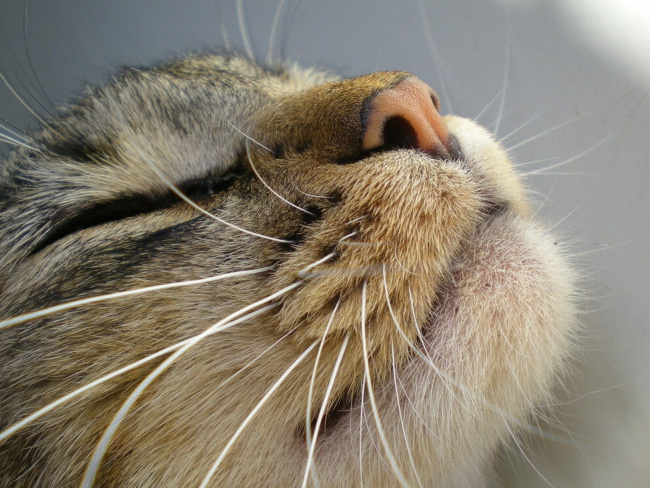
More precisely, tactile hairs. They are stiff, sometimes very hard, and protrude above the surface of the fur. Their roots are immersed in a blood-filled sac called a sinus.
On the wall of this sinus are tactile corpuscles, which are stimulated when the sensitive hairs move. A single movement of a sensitive hair stimulates many nerve cells, so that even a light touch is enough to elicit a response. Cats have two hairs on each cheek, up to twelve above the eyes, up to thirty on the upper and lower lips, and up to six on the paws. Sensitive hairs are necessary for cats to feel. For example, when jumping on prey, the whiskers are stretched out to mark every movement of the mouse. If the prey is caught and seized in the mouth, the whiskers register the behavior of the victim, which is currently out of the cat's field of vision. When it begins to tear apart its prey, it feels it with its whiskers to make sure it starts with the head.
When walking, the whiskers are tense and spread out in all directions. Together with their keen eyes, they form a well-coordinated system that provides spatial orientation. It is said that the ends of the splayed whiskers correspond to the width of the cat's body, and if it needs to squeeze through a narrow opening, they allow it to orient itself — whether its whole body will fit through after its head. This is certainly not the case with young cats, whose tactile hairs are still growing.
A mustache is unlikely to help an overweight cat squeeze its protruding belly through a narrow opening. As for proportionally developed animals (i.e., those that are properly fed), this is entirely possible. And even the fact that cats sometimes get stuck in narrow passages, chimneys, pipes, etc., does not refute the above. This is because it is usually inexperienced animals that get into trouble. Cats also have to learn first in order to fully master all their abilities. And cats, like all highly developed animals, learn by trial and error.
Cats use their hypersensitive whiskers with extreme caution. Barely touching, the cat strokes the surface of the object that interests it with its hairs, much like a blind person “sees” with the help of hypersensitive fingertips.
By the way
In the world of living beings, touch is of enormous importance.
It also plays an important role in the sexual sphere. The rapprochement between the sexes is stimulated by pleasant tactile sensations: touching, stroking, feeling, perceiving.
It is no coincidence that a cat's fur can stand on end and move in all directions.