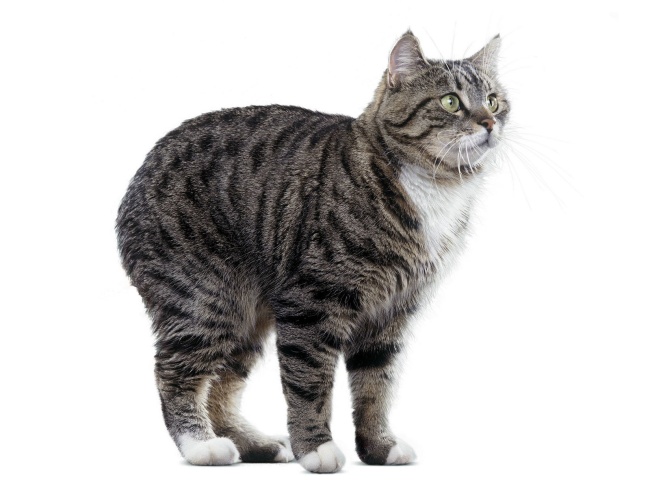
Manxes (Manx) are unusual cats with a rabbit article and a rounded, fluffy tailbone. Charming, good-natured and calm creatures, they are characterized by malleability in communication with humans and pets. These cats become easily attached to their owners and feel the need to socialize with them. Despite their unusual appearance, Manxes are excellent hunters, agile and agile. One of the most important conditions for admitting this breed to shows is the presence of a clearly palpable depression where the tail begins.
History of the breed
The population of tailless cats has existed on the Isle of Man for several centuries. Thus, mentions of these animals are found in local historical chronicles of the XVIII century. The inhabitants of the island have invented many legends explaining how the charming creatures lost their tails, but the true cause of such a mutation, most likely, was inbreeding, because the island's population of cats was almost never replenished from outside. Manxes have received national recognition - the figure of the tailless cat was depicted on the reverse of the one krone coin in 1970.
Felinologists have developed a clear gradation of tail expression in Manxes. Rampy cats are called cats with a completely absent tail, raiser - rudimentary tail in the form of a tubercle, stumpy - a short but visible tail, stubby - tail shorter than the usual length for cats and longy - tail of standard length. Rumpies are forbidden to cross with rampies - their offspring do not survive.
Care
Maine cats are characterized by cleanliness and do not require special care. A short, but dense coat of Manx cats is advised to regularly comb out two or three times a month. During the molting period, it needs additional care, namely ironing with wet palms to remove shedding hair.
Since the absence of a tail is the result of a genetic mutation, kittens of this breed in the early stages of development can have serious spinal disorders.
Breeding
The tailless cat can bring both tailed and tailless kittens in a litter. Crossbreeding of two tailless cats is prohibited. And although only tailless individuals are allowed to participate in shows, tailed cats of the same breed are actively used in breeding. Recently, crossbreeding of Manxes with representatives of other breeds has been practiced. The work of breeders is carried out in two directions: the preservation of pronounced taillessness and the elimination of genetic abnormalities that negatively affect the health of the pet.
In America there is purposeful breeding work with Manxes to improve their variety - long-haired Maine cats, called Kimrick.