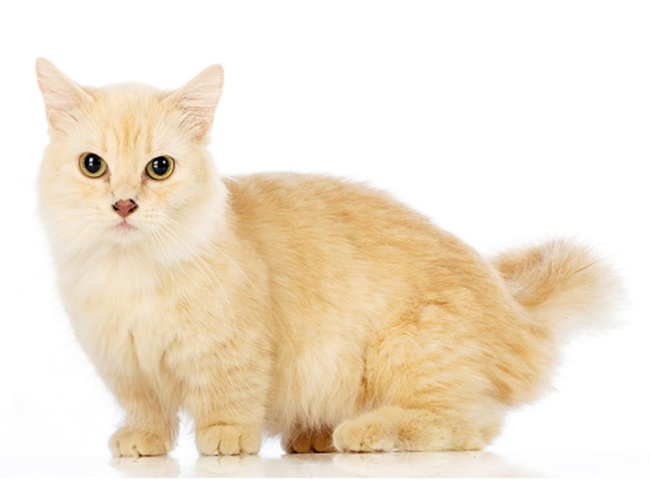
The Munchkin is one of the most unusual modern cat breeds. With an average body length, their legs are two to three times shorter than those of ordinary cats. Because of this peculiarity, they are sometimes called dachshund cats. These creatures are intelligent, agile, easily get acquainted with new people, like to walk on a harness, calmly relate to the change of residence and are attached more to a person than to the house.
History of the breed
Munchkins appeared as a result of a spontaneous mutation of domestic cats, which is caused by the presence in the genotype of the dominant gene achondroplasia, leading to skeletal damage, i.e. dwarfism and short limbs with the usual length of the torso. The first mention of short-legged cats dates back to the 1930s, but the breed was officially discovered in 1983 in the state of Louisiana: an American woman Sandra Hohenidel found and sheltered the strange-looking animal.
The breed was named after the magical people from the book The Amazing Wizard of Oz.
Care
Care for the munchkin is not difficult. Short-haired animal is enough to comb out once every few weeks, long-haired - once or twice a week. Bath munchkins should be bathed as needed. Feed is suitable for both ready-made and natural. Munchkins are a healthy and cheerful breed, not subject to specific hereditary diseases.
Usually, to look around, these munchkins stand on their hind legs and then sit down, using their tail as a support. They can stay in this position for quite a long time, and their short legs hang down, giving them a resemblance to a kangaroo. Because of this there is another unofficial name for the breed - kangaroo cat.
Breeding
Short-legged offspring can be obtained by crossing the Munchkin with any other breed of cat. If one of the parents is a munchkin, then among the kittens will be about 50% short-limbed. Today, by crossing munchkins with different cats, new independent breeds such as Napoleon (munchkin and Persian) and Bambino (munchkin and sphynx) have been developed.