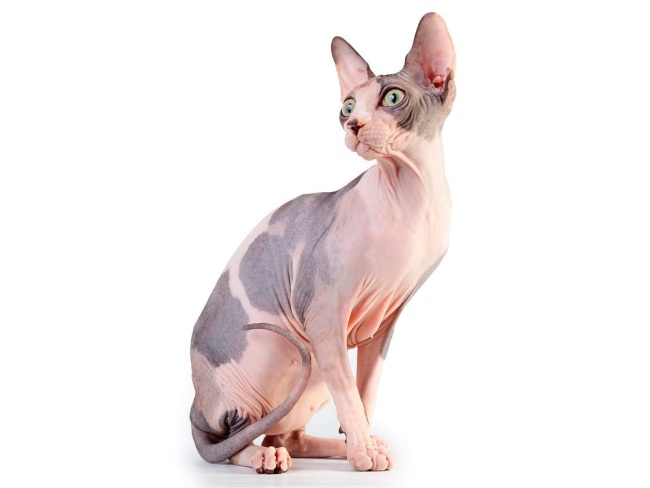
The Canadian Sphynx is the first recognised breed of hairless cat. If you want an animal that does its own thing and does not need to socialise, the Sphynx is not for you. These creatures need constant companionship. Canadians are very intelligent and easily learn new things. They are friendly with absolutely everyone and get along well with children.
History of the breed
In 1975 in the state of Minnesota a naked kitten was born to a short-haired cat, and a year later - the same kitten. It was these animals that became the founders of the breed in the United States. In the late 1970s, three more bald kittens - a male and two females - were found on the streets of Toronto. The found male was badly mutilated and could not become the ancestor of the breed. But the cats went to Holland, where they laid the foundation of the European line of Sphynxes.
Care
Sphynxes, unlike canine, do not need additional care. The body temperature of these cats is higher than in cats of other breeds, indicating an accelerated metabolism. It is not surprising that sphinxes have an increased appetite, so you need to make sure that the animal does not overeat. It is necessary to be sure to purchase a scratching post: these animals have small pads of paws, so their claws are not completely retracted, the folds on the skin and because of the lack of wool on the paws steps are not muffled.
Interesting fact: Sphynxes sweat. Their sweat is odourless, but when it comes into contact with air it turns dark brown and can leave traces. Usually it is not much, and animals do not even need to be bathed often, it is enough just to wipe regularly with a damp cloth.
Breeding
The gene of hairlessness in Canadian Sphynxes is recessive, so when crossing with other breeds, there will be no naked offspring in the first generation. It can be obtained only by backcrossing, if both parents are carriers of the hairlessness gene.