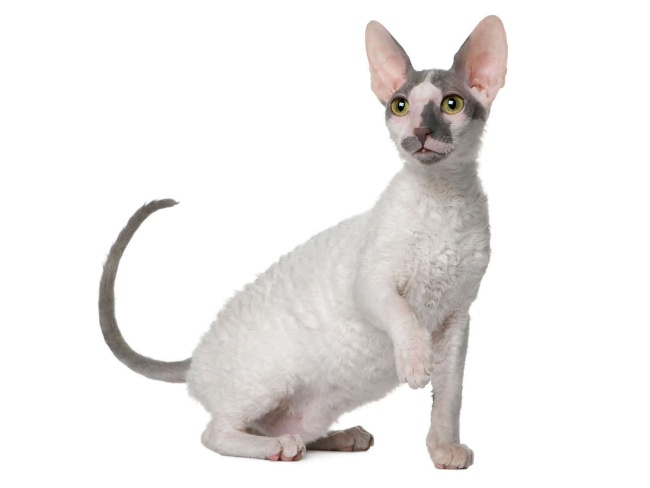
Cornish Rexes are very intelligent, attached to their owners, perfectly trainable and even allow themselves to be walked on a leash. These animals are characterised by innate intelligence and aristocracy: cats do not mark the territory, do not steal from the table, do not rub on everything and everyone. Representatives of this breed are absolutely non-aggressive and not vindictive.
History of the breed
The first Cornish Rexes appeared in the county of Cornwall as a result of spontaneous mutation. In 1950, an unusual kitten was born on a rabbit farm. It was thanks to him that the breed got its name. Since 1957 they have been bred in the USA, where they were classified in 1979. By 1983 the standards developed in these two countries were recognised by all felinological associations of the world.
The point is that rexes are called royal down rabbits (which also have only an undercoat), so the cats, which are devoid of awn hair, were given a similar name. Subsequently, the name was no longer associated with the structure of the hair cover and under it began to unite all curly cats, even with awns.
Care
Cornish Rexes have an excellent appetite and are prone to overeating, so the pet's diet should be controlled. Representatives of this breed have excellent immunity and good health. Hereditary diseases are not observed. However, they should be protected from draughts and hypothermia.
Breeding
A recessive gene is responsible for the curly coat of the Cornish Rex, so at the very beginning of the breeding works to prevent inbreeding Rexes were crossed with other breeds - Siamese cat and ordinary domestic. At present, crossbreeding of Cornish Rexes with other breeds is prohibited. According to breeders, it is easy to breed these cats: they have good health, have an excellent gene pool, do not require assistance in childbirth.