
Scientific Classification
| Kingdom |
Animals
|
|---|---|
| Phylum | |
| Class | |
| Order | |
| Family | |
| Subfamily | |
| Genus | |
| Species |
Mellivora capensis
|
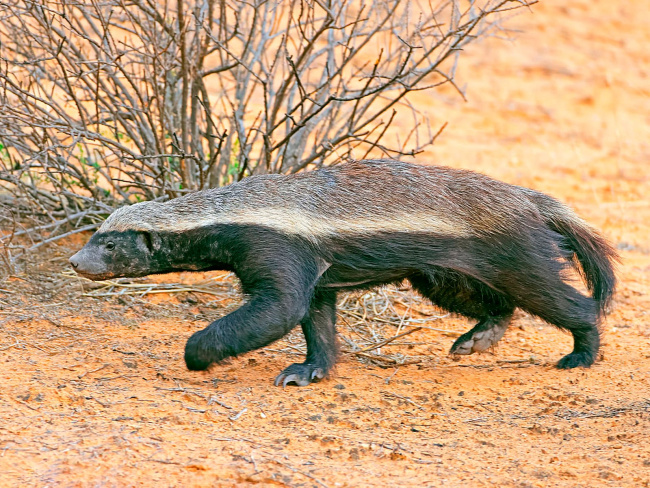
The honey badger (Latin: Mellivora capensis) is very fond of honey. It also likes fish, lizards, frogs, poisonous snakes, scorpions, small rodents, birds and their eggs, roots and insects.... In short, God had not invented anything that this beast could eat. The bald badger eats absolutely everything. That's what makes it so dangerous.
The honey badger does not forgive insults
Appearances are deceiving. And the honey badger, aka the bald badger, aka the ratel, is direct proof of that. Looking at him, you can never say that this animal is characterized by terrorist tendencies. Its eyes are clever, its face is cute, its feet are stubby, and its coloring is amazing: the whole honey badger seems to be divided into two parts - white on top and black underneath. Very refined outfit. Badgers and skunks wear similar outfits. And the honey badger resembles both at the same time. And by the way, like the skunk, he, sensing the slightest danger, begins to emit a sharp stinking odor. But it never runs away from a potential threat. The bald badger acts exactly the opposite, understanding that the best defense is offense. In addition to a cute face, nature has provided the honey badger with powerful jaws and long sharp claws.
The courage and aggressiveness of this African honey lover is legendary. A small animal, and the length of an adult male from head to tail reaches only one meter, so brave that he does not cost nothing to attack a leopard or even a lion. On the Internet, if desired, you can find more than a dozen videos that captured the fights of honey-eater with large predatory cats. And from all of them, the bald badger comes out victorious, fleeing his opponents. He's a berserker!
It seems he, like the ancient Scandinavian warriors, deliberately puts himself into a heightened state of aggression before battle. Like the glorious warriors of Odin, in battle the honeybee is characterized by fierceness, strength, lightning-fast reaction and insensitivity to pain.
In addition, it is also very persistent: an enraged honeybee can chase its prey for great distances. He is a recognized marathon runner who can catch up with a cheetah if the latter crosses his path. The cheetah is a sprinter who quickly runs out of breath. The honeybee, on the other hand, has an inexhaustible reserve of strength. And so woe betide anyone who touches him, willingly or unwillingly. The bald badger does not forgive offenses.
Give me more poison
Psychologists would diagnose the honeybee as having a Napoleon complex. But zoologists do not give rest to another mystery of this amazing beast. The fact that he is insensitive to poison, and therefore the bites of poisonous snakes for him is like mosquito bites. At first, the researchers thought that all the matter is in the thick skin of bald badgers: allegedly reptiles simply simply are not able to bite their skin. On the other hand, another animal is enough to get a scratch in a fight with a cobra, for example, to go to the dust. The honey eater doesn't give a shit. And then with what in Africa and Asia there is no deficit, so it is with snakes, including very large and very poisonous. There are African vipers, and black mambas, and green mambas, and boomslangs, and Egyptian cobras .... And none of them can bite a honey eater properly? Of course they can. But it was only in the 20th century that scientists were finally able to see what happens to a bald badger after a collision with reptiles.
For five minutes he convulses, it seems that he is about to give his soul to God, then he falls silent and ... gets up and goes about his business as if nothing had happened. He has some special antidote, the secret of which people have yet to discover. The honey badger turns its uniqueness in its own favor: snakes are the main part of its diet. His appetite is excellent. And if we remember that the main life principle of the bald badger is absolutely Suvorov's: the main thing for him is to get into a fight, it is clear that no snake - even the largest and most poisonous - leaves him alive.
A consummate loner
The honeybee, as the owner of a ferocious temperament, is a perfect loner. Society is not that he does not need, it is contraindicated.
In the wild, he does not let either humans or other animals, let alone his own kind. He marks his territory to prevent other ratites from coming to it. And is ready to fight to the death against invaders.
By the way, the possessions of the bald badger is almost a hectare of land. A small kingdom for such a “huge” beast, which is a whole poodle of weight! Of course, for martens, whose representative is the honey badger, these are serious weight figures. However, let's be honest (the rabbit can't hear us): compared to other predatory inhabitants of Africa and Asia, the bald badger is a mere trifle. But look at you - has struck fear on the entire Black Continent. And it's not just the character of the bald badger. The honey badger is naturally intelligent. He is one of the few animals who uses in his daily life “handy tools”. For example, the honey badger can drag a stump to a tree to climb it and reach the hive. He digs holes in the clay during droughts to collect water. He is also very attentive and memorable.
In short, God had put a lot of labor into it. Probably, he wanted his especially successful creation to breed and multiply diligently. Alas, honeybees reproduce very rarely. In the wild it happens only once a year, or even in a year and a half. In captivity, the honeybee cannot be forced to reproduce by any force. Sexual appetites of the ratites are very, very moderate. They don't know how to groom. The maximum that the males are capable of is to tolerate the female on their territory and not give her a beating. To see how honeybees walk in pairs, you can only during the mating season. At the same time, if a female becomes pregnant, the male immediately leaves her. The bald badger takes care of her future home, offspring and their food exclusively on herself. She gives birth to few cubs - maximum two. The cubs stay with their mother until their adulthood, which comes at the age of 1.5 years. After that they safely forget the old mother and go in search of their hectare of land. Africa and Asia are large continents, and there are few honey-eaters in them, so there is enough space for everyone.
Friends and enemies
The only creature with which the honeybee is friends is the honeybee pointer bird. This alliance is based on mutually beneficial cooperation. The bird finds a nest of wild bees and brings the honeybee to it with the well-founded hope of eating the scraps from the table. The honeybee, who is an excellent tree climber but only does so when absolutely necessary, reaches the bee's nest and tears it with his strong claws. He is not afraid of bee stings. Therefore, he eats all the honey, and leaves the honeycomb to the honeybee. And the bird nibbles all the wax together with the larvae.
Honey can rob a honey-eater of his self-control. It makes the bald badger lose his head. At the moment of feasting, he could be easy prey for predators. It's a good thing no one's messing with his person. And since we all know that “if there's honey, there's no honey”, the honey badger's insanity is extremely short-lived.
In the absence of honey, the honeybee eats everything that moves and that does not move, even carrion. Although it has another weakness - chicken.
For this reason, the relationship between humans and bald badgers, to put it mildly, does not work out. A honey badger can easily dig under a hen house. And once inside, the beast will not leave until it kills all the chickens. Dogs are absolutely powerless against the Honey badger: they are not able to bite its thick skin. In addition, due to the presence of a layer of subcutaneous fat, the skin of the Honey badger is quite freely “attached” to the body. If he is attacked from behind, he can easily twist away. And then the attackers are in trouble. Therefore, the maximum that dogs are able to do is to tear off the voice of a shrill bark, calling for help from the owner. The only way to kill a honey-eater is to shoot it in the head at point-blank range. Or hit it with something heavy. Not humane, yes. But it's the only way to keep a honey-eater out of the henhouse. He's hungry for chickens.