
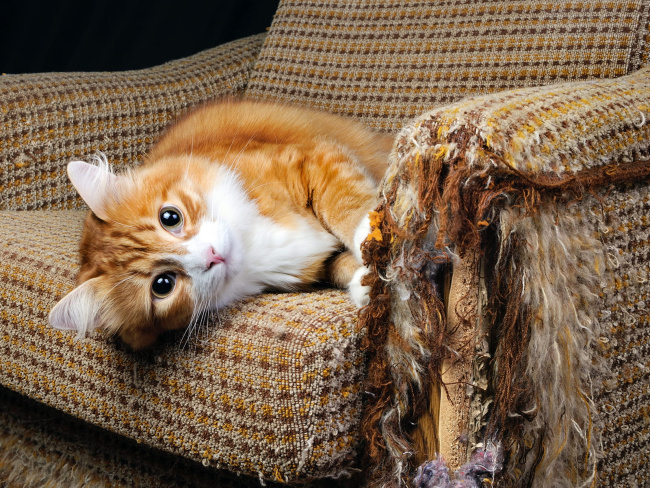
If you find a claw, don't panic.
This process is more like snakes shedding their skin than sharpening kitchen utensils. If you run your hand over the spot where your cat just scratched the furniture, you may find a torn-off claw, and owners often fear that their pet has injured its paw by accidentally catching it on a sturdy fabric. But this is nothing more than the outer shell, ready to be shed.
The procedure for sharpening the hind paws is different: cats process them with their teeth.
The second important reason for damaging furniture with paws is to train and strengthen the mechanism of retracting and extending claws, which is very important for catching prey, fighting rivals, and climbing trees.
And the third reason, which most people don't know about, is marking. On the back of a cat's front paws are glands that secrete a pungent-smelling substance. When sharpening their claws, these glands rub vigorously against the fabric. Rhythmic scratching, first with the right paw and then with the left, ensures that the substance is released and rubbed into the fabric, leaving a kind of personal signature on the furniture. This is why your favorite armchair often becomes the object of your cat's attention — it wants to add its scent to your personal scent.
By the way
Cat paw pads are covered with modified skin, which makes them much stronger than regular skin. These hard pads have three purposes: to soften impact, connect the bones of the toes, and act as brakes.
In desperation, some cat owners resort to the cruel practice of declawing their pets. In addition to physical pain, this also causes psychological damage to cats, as it puts them at a significant disadvantage when hunting, in the event of conflict, or when they need to climb a tree to escape. In a word, a cat without claws is an incomplete animal.
Scratching posts
Some owners purchase special, expensive “scratching posts” that are thoroughly soaked in catnip to attract the animal, and are bitterly disappointed when the cat ignores the purchase and continues to scratch the furniture.
You can try to solve the problem by hanging an old sweater on the “scratching post,” but if the cat has already chosen a certain chair as a specific place to sharpen its claws, it is extremely difficult to break this habit.
How to stop your cat from damaging furniture
If your cat ignores the scratching post and continues to scratch furniture, you can use a system of rewards and punishments to break it of this bad habit. Below are some effective methods that have been used by many pet owners for years.
Keep a spray bottle of water handy and every time your cat approaches the furniture and starts scratching it, gently spray water on its face. This is unpleasant but not dangerous, the main thing is to avoid getting water in its ears. Be persistent and patient, and soon your cat will understand the connection between cause and effect.
Cats really dislike sticky surfaces. You can stick double-sided tape on the furniture that your pet has chosen, or smear something sticky on it. This is a temporary measure; after a couple of weeks, you can remove the deterrent.
If you catch your cat in the act, do not ignore this behavior under any circumstances. You can yell at your pet or clap your hands loudly. This is an excellent method that works when used systematically, and over time, your cat will understand that it is not allowed to touch the furniture.
You can use repellent smells. For example, cats cannot stand the smell of citrus fruits. Veterinary pharmacies and pet stores sell special liquids that can be sprayed on furniture to repel animals.
- Well, a radical method that is not suitable for everyone is to close the door to the room. If you create a comfortable space for your cat, for example, in the kitchen, you can leave the door to the rooms locked. However, this does not guarantee that the cat will not scratch the kitchen furniture.
As you can see, there are ways to wean your cat off this bad habit. But it is important to understand that every animal has its own unique temperament, and what works for some pets may be useless for others.
Proceed with caution, do not use physical punishment, be patient, and everything will work out!