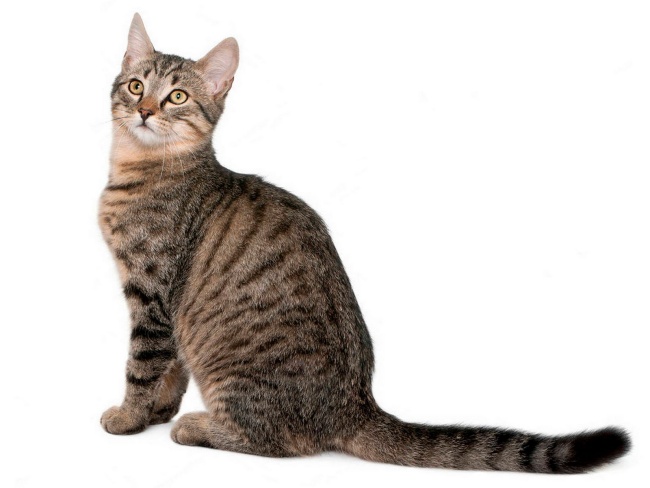
It is a medium-sized, harmoniously built animal. Compared to the British Shorthair, the European Shorthair is characterised by an elongated nose, a more graceful build and less prominent cheeks. These creatures are playful, affectionate, sociable, but not intrusive, walking on their own and independently decide when to make contact.
History of the breed
Since the European is an aboriginal breed, it is quite difficult to find out who was its ancestor. Felinologists disagree: some believe that it was semi-wild cats that have always lived in Europe, while others suggest that short-haired individuals were introduced by the Romans. Currently, the European Shorthair is almost the most common breed, although not very popular. Many felinologists consider it to be too common to engage in selection.
Care
Care for the European Shorthair is simple: trim its claws regularly, bathe it and comb its fur as needed. Cats of this breed are genetically healthy, have excellent immunity and live a very long time if kept in the right conditions.
Representatives of the European breed have a real feline talent - they are excellent at catching rodents. In 1938 at an exhibition in Berlin, a rat cat was demonstrated, and since then its brethren have been called "the storm of barns".
Breeding
Any signs of admixture of another breed are considered defects. This includes long hair, a too compact or graceful body, and a pronounced stop on the nose (as in the British). Colours of Europeans are allowed practically any. Categorically unacceptable point, chocolate, mauve, fawn and cinnamon (they are peculiar to Asian breeds) in any combinations. Eye colour can be any, corresponding to the coat colour.