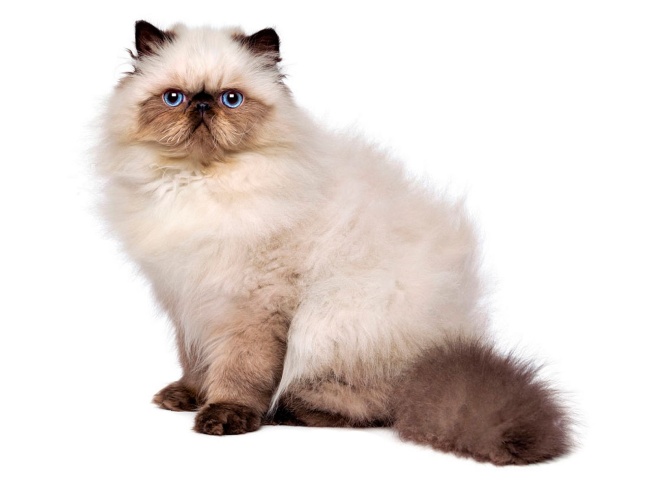
This is a long-haired cat with a characteristic color point (light body with darker paws, tail, ears and a characteristic mask on the face). In many ways, this breed is similar to the Persian, from which it originates. Himalayan cats (Himalayan cat) are more active than Persian cats, they like to play and bask in the sun, and most of all - to follow their owners and participate in all the affairs of the family.
History of the breed
The Himalayan breed was the result of purposeful crossing of Persian and Siamese cat lines. The result was Persian cats with the color point gene. At the same time in Great Britain there were independent works on creation of similar breed. A distinctive feature of the "British" variant was a more elongated muzzle and intense color.
For a long time, long-haired cats with color point were considered as a variety of Persian cats, but in the early 1960s, the Himalayan breed was recognized as an independent breed.
There are two possible variants of the shape of the stop (muzzle): a prominent stop, the so-called doll's muzzle, and a strongly pronounced one, the "Pekingese muzzle".
Care
Like any long-haired cat, the Himalayan requires increased attention to the care of hair. It is combed out in three steps: first with a comb with sparse teeth to straighten the strands of dense coat, and then more frequent to remove dead hairs. At the very end, combing with a brush made of natural bristles, from which the coat is fluffed up and acquires an exhibition look. Animals are hard to tolerate being in a confined space, so they should be given maximum possible freedom of movement around the house.
Cats with a pronounced flattened muzzle ("Pekingese muzzle") often have problems with tear production. The eyes should be examined regularly and the muzzle washed if necessary.
Breeding
A litter of Himalayan cats usually contains three or four kittens.
Color-point color is fully formed by two to three years. The familiar "Siamese" color, it turns out, is the result of acromelanism - incomplete albinism, when the color of the coat depends on the body temperature of the animal: where it is warmer, less pigment is produced, and vice versa. This is how Siamese, Thai and Himalayan breeds get their color point.