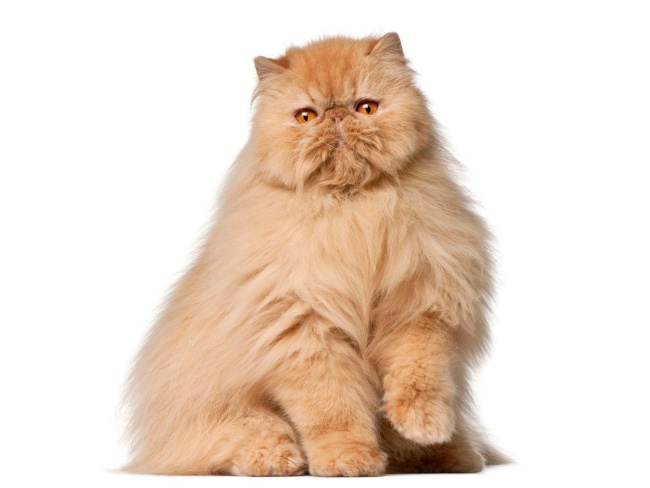
Persians are a very domestic breed. They are the most patient representatives of the species: they allow themselves to be washed, scratched, and their eyes cleaned. They are very mobile, if you play with them, they are happy to run after the ball, catch insects.
According to the main feature of the breed - flat nose - there are two types: extreme - the nose is very small and very upturned, classic - a relatively long and slightly upturned nose.
History of the breed
The official history of the breed began in the XVIII century, when the ancestors of these cats were brought to Europe, according to some data, from Persia (Iran), hence the name. Later the animals came to England, where at the end of the XIX century. began to purposefully carry out breeding work, in the course of which the Persian and Angora types of long-haired cats were isolated.
In the 1970s, many catteries appeared in America, which led to a number of changes in the breed, and not for the better. About 20 years ago, specialists managed to breed a typical, compliant, healthy cat.
Care
This breed is one of the most difficult to care for. Every day, the long coat needs to be powdered with talcum powder or a special chalk-based powder and then brushed out thoroughly. In addition, the cat should be bathed regularly.
This breed has two significant defects that arose in the breeding process. The first is a very short flattened nose with a deviated nasal septum, which interferes with breathing: cats constantly sniff and even snore. The second defect is a problem with the lacrimal glands. Because of this, mucus accumulates in the eyes, which must be regularly removed.
Choosing a kitten, people most often want to take a female, believing that she is more affectionate and malleable. However, this behavior is not characteristic of Persian cats. Males are much more gentle than female representatives of the female sex, who are independent, independent and often busy with more important things than communicating with the owner.
Breeding
To preserve the breed qualities of Persian cats, it is important to use purebred breeding and be sure to select pedigree producers. It is not allowed to mate cats with exterior defects, genetic abnormalities.