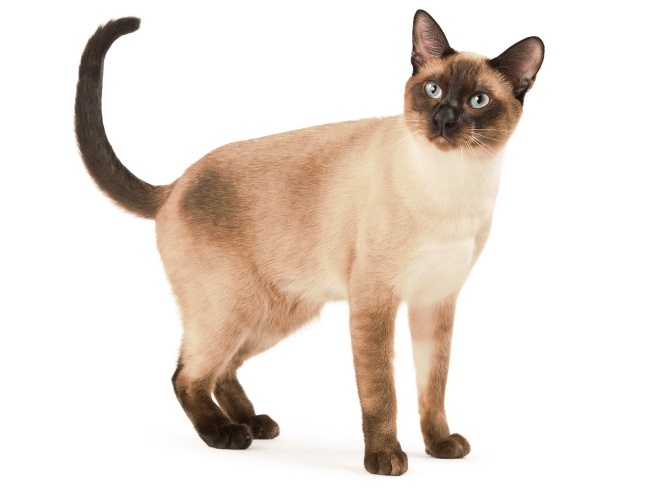
Thai cats (Thai) are very "talkative", often give voice and express their emotions with the help of various intonations. Thai cats tend to divide people into their own and strangers: they are always affectionate to the owner, but may be wary of strangers. They can even grumble, but usually do not show aggression.
History of the breed
In the mid-1950s, the leading felinological organizations in Europe and the USA introduced new standards for the Siamese breed. However, some breeders continued to breed animals of dense build, cheeky and apple-shaped head. As a result, the Siamese traditional breed was formed. In 1990, fans of traditional Siamese achieved registration of the breed in the World Cat Federation (WCF). The breed received a new standard and was named Thai.
Care
Thai cats, like other short-haired cats, do not require special care. Their fur does not roll, does not need frequent combing and washing. It is enough to comb the pet a few times a month, as well as remove dead hairs with a wet palm. Claws should be trimmed from time to time.
Because of the content in cold climates, the coat of Thais can darken, and in very warm, on the contrary, lighten - this is a property of the color.
Breeding
Colors are diverse. There are Thai cats with monochrome markings (black, brown, blue, etc.), with tabby pattern (stripes) and tortie (spots, tortoiseshell color). White spots on the coat and curvature of the tail are considered defects of the breed.
There is an opinion that Thai cats are harmful and vindictive, but this statement is erroneous. Thais, like representatives of other eastern breeds, are active, demanding and often stubborn. However, they are very intelligent, friendly, strongly attached to the owner and devoted to him all his life.