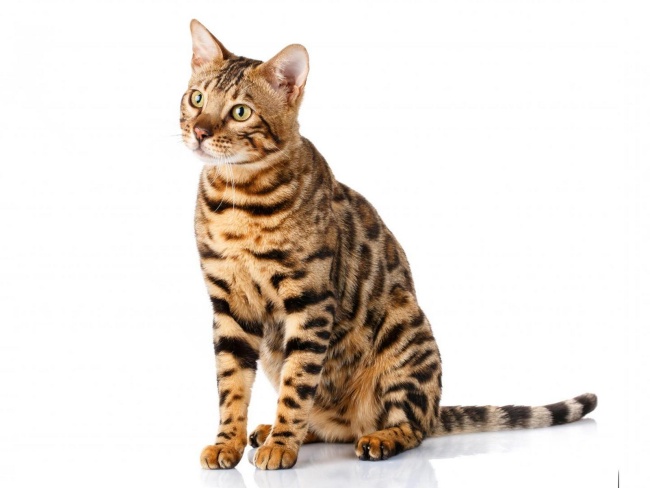
The Bengal is considered one of the rarest and most expensive breeds.
The Bengal cat is considered one of the rarest and most expensive breeds. These cats combine the traits of a predator and a house cat: they are active, love to hunt, play with water, but are not dangerous.
History of the breed
American amateur felinologist Jane Mill decided to cross a tame female wild Bengal cat with a male domestic cat in the 1960s. The experiment was successful, and by the end of the 1980s, Mill had succeeded in breeding animals that consistently passed on their traits to their offspring. The breed was officially recognised in 1991 and began to rapidly gain popularity.
Care
The Bengal cat has a beautiful short hair, which does not necessarily need to be combed. Such a procedure, as well as bathing, should be resorted to only in periods of moulting. Animals are very fond of water, so it is sometimes difficult to kick them out of the bathroom. Bengals have long claws, which should be carefully monitored and trimmed regularly. This is a healthy and genetically strong breed.
Breeding
The kitten must be a descendant of a wild Bengal cat of at least the fifth generation, otherwise its temperament is likely to be a little wild. The main difficulty in breeding this breed is that there are very few breeding individuals and wild Bengal cats have to be used to create new breed lines.
Bengal cats need to be hand-trained from early childhood, as they quickly become wild in solitude and begin to avoid humans.