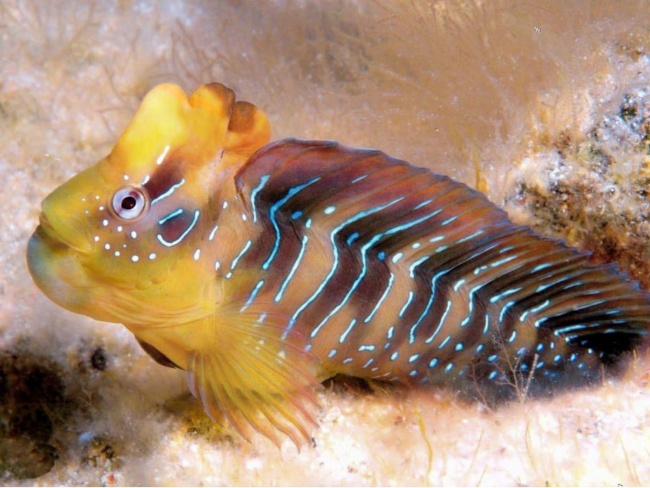
Male dogfish peacock in its luxurious mating attire is as beautiful as many coral fish.
The peacock dogfish is an amazing fish that can move on land, has an unusual helmet on its head, its coloring really resembles a peacock and is also extremely curious.
Naturally, despite its harmful character, this doggie is a desirable object for many aquarists and scientists, to which the fish gets used to very quickly and can even take food from hands.
SURPRISED BULLDOG
The body of the dogfish peacock is flexible, elongated, compressed from the sides. The head is quite massive, with a large mouth, fleshy lips, chubby cheeks and bulging eyes, reminiscent of a bulldog's head. The mouth has two rows of sharp teeth, complemented by four large bent canines. The crease above the upper lip combined with the widened throat and convex forehead gives the doggie's "face" a haughty and surprised expression. It has no swim bladder, as well as scales, and the body is covered with a layer of mucus. From the top of the back of the head to the end of the tail stem stretches a long dorsal fin, half of the rays of which are barbed and flexible, and half - soft. The caudal fin is rounded. From the end of the short abdomen to the tail goes anal fin. The small spiny pelvic fins lie almost on the throat. Pectoral fins, located after them, have the appearance of massive fan-shaped paws. In general, the fish is a mini-copy of its relative - northern catfish.
PAVLINY NARRATION
The coloration of the dogfish is quite variable and depends on the area of habitat, character and color of the ground. The overall color varies from olive gray, yellow-brown and green to pink-red. On the body are 6-8 vertical dark twin bands, outlined with thin turquoise-white lines and passing to the dorsal fin. Between the stripes and closer to the tail scattered the same turquoise-white dots. Through the eye is an oblique black stripe, masking the pupil, and a little farther to the back of the head is a false eye of two dark rings. The dorsal and caudal fins are often highlighted in red.
KING OF THE MOUNTAIN
Dogfish - marine bottom fish, living in coastal areas with rocky or shell bottom and aquatic vegetation. The zone of their distribution - shallow areas (usually 0.5-1 m) of the Black Sea, the Mediterranean Sea and the European subtropical part of the Atlantic. Observe the life of dogfish can be practically without getting their feet wet - adult fish fond a stone, climb on it and with an important look sit on top, spending so almost all day, or trot between the stones in search of food.
Usually they prefer small crustaceans: bocoplaves, water donkeys, shrimp, small crabs, but do not refuse the opportunity to nibble thread algae, eat a worm or someone else's eggs. Noticing an impudent encroaching on the stone chosen by them, the dogs belligerently thrust their fins with barbs and rush into battle, as in the children's game "King of the Mountain". If within sight of someone else found food, run there and snatch the prey from each other's mouths, like real dogs. Thick mucus allows them to be out of the water long enough. Being thrown ashore by a storm or carried away in pursuit of small crab, dogfish easily return to their environment, wriggling snake-like or jumping, pushing off the ground pectoral fins as paws. When caught on a fishing line or attempting to grab them by hand, they wiggle and lash out in a doggie-like, painful way to grab your finger.
DOGGY WITH HORNS
At 1.5-2 years fish are ready to reproduce. At the "grooms" on the head grows a hump-helmet, which, like the elk horns, serves as a sign of masculinity. In addition, they acquire two fleshy blades at the beginning of the anal fin, which help in spawning. The "brides" have a noticeably swollen abdomen. The coloration of the nuptials becomes brighter, turquoise stripes light up like neon advertising, and the males begin to sparkle like peacocks, for which these fish and got their name.
MULTIPLE WEDDINGS
Mating occurs in portions from May through July. During the nuptial period, the male builds a nest of large bivalve shells under rocks, in cracks and crevices of rocks or digs a hole in dense sand with his mouth. Then dances to lure a female ready to spawn, climbs into the nest and starts waving his head vigorously and bowing, inviting the charmer inside. If she does not agree, he jumps out and pushes her in by force. Having performed the wedding ritual, the satisfied suitor sends his wife out and begins to lure another one in. This continues until the dwelling is filled with several thousand weakly sticky yellowish eggs, 1.2-1.3 mm in size, with white spots, characteristic of the peacock dogfish.
RESPONSIBLE DADDY
For 15-20 days, the male takes the house under guard: clean and ventilate eggs fins and drives away those who want to eat it, attacking even his own reflection in the mirror offered. At the same time, he does not stop eating, reinforced by the most annoying thieves - bocoplaves, water donkeys and shrimp. Seeing such passions, hatched youngsters immediately run away from the nest and begins an independent life in the water column, eating small phyto- and zooplankton, as well as filamentous algae. Females after spawning eat "dietary salads" of diatoms, scarlet and green algae.
Interesting facts
When containing doggy peacocks in the aquarium together sit one male and several females, as several males will constantly share the territory and the weakest of them can die.
Brief description
Class: bony fishes.
Class: bony fishes.
Family: dogfish.
Genus: dogfish.
Species: sea dogfish pavlin.
Latin name: Blennius pavo, Salaria pavo.
Size: length up to 13 cm. Weight: up to 24 g.
Coloration: yellow-green or creamy-pink, with dark and thin turquoise-white stripes and dots.
Life expectancy of the peacock dog: 5-7 years.