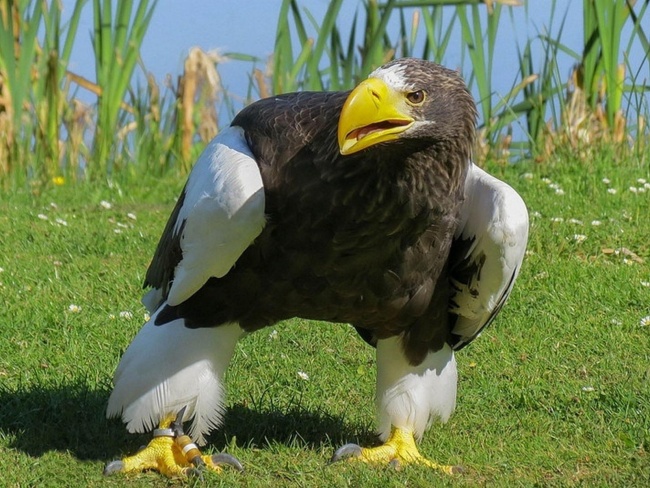
The Steller's sea eagle (aka sea eagle, Steller's sea eagle, Pacific eagle) is an amazingly beautiful and majestic bird. The main color of the plumage of adult birds is black-brown. Against this background, pure-white spots on the wings (shoulders), white wedge-shaped tail, "pants" on the legs and the base of the beak catch the eye. The beak itself is huge, massive, slightly bloated, bright yellow or orange in color. It is visible from afar and in any weather. The legs are also bright yellow. Birds put on such an outfit by the age of four or five. Young eagles are completely brown, with ochre colored stripes. As they grow older, the amount of white in the plumage gradually increases.
This marvelous bird is endemic to Russia. This means that it nests only in our country, on the coasts of Kamchatka, the Far East, Sakhalin and the Kurils. Georg Steller, the famous naturalist of the First Kamchatka expedition, was the first to describe the "mottled magpie-colored eagle" (hence the name "Steller's eagle"). The eagle was actively studied only about 30 years ago - at the end of the last century. Since then a lot of interesting information about its habits, biology, nutrition and reproduction has been accumulated.
ON THE BEACH
Favorite habitats of eagles are river valleys and sea coasts. It never flies far from the water, nests are located most often 0.5-1 km from the shore of the sea or lake. Eagles are conservative in everything. They choose a pair for life, a place for a nest and an area - too. These giants grow up late, only by the age of 7-8 years, although they split into pairs 2-3 years earlier. The young stay together for several years, choose a site, but do not nest, although they may build "ritual" nests. On successful coasts, nests of different pairs may be 1-2 km apart; if food is scarce, they have to disperse, and then one pair is separated from another by 8-10 km, or even more.
NEST-FORTRESS
The eagle is a large bird, so its nests are not small either. A newly built nest can reach 1 meter across and almost the same height. However, birds of prey do not build a new nest every year, as small passerines do, but only renovate and add to the old one. And after a few years, the structure often reaches a huge size - up to 3 meters! It can easily accommodate 2-3 people. The main building material of the nest is large tree limbs, and the tray is lined with smaller branches and dry grass. Nests are located on large trees with flat tops, on the very top, and sometimes on rocks. The point is that with such long and wide wings and a massive torso, the eagle simply could not fly to the nest if it was "hidden" somewhere in the middle of the trunk.
LONG CHILDHOOD.
In spring, April-May, the female lays from one to three eggs (most often two). Only the female lays eggs, the "husband" guards the nest and brings food. She incubates for a long time - about five weeks. The hatched chicks, covered with long white fluff, are very hungry, so both parents hunt tirelessly, primarily for fish. During the day, the birds feed the chicks 2-4 times, bringing large pieces of food and plucking a little for each hungry mouth. If there is a lot of food, the younger chicks have a chance to survive until flight, but this rarely happens, more often only one chick flies out of the nest. Growing up, the chicks change their white down to a dense gray down, through which brown feathers - the adult raptor's attire - soon begin to show through.
The chicks stay in the nest for a long time, up to 2-2.5 months. Having fledged, they gradually begin to climb out to the edge of the nest and train, intensely flapping their wings and bouncing. And one day, having made up their minds, they take off! At first the chicks stay close to the nest, together with their parents, and then they start to live independently.
HUGE "FALLING LEAF"
In Kamchatka and the Far East, eagles are the main consumers of salmon. They catch not only live fish, but also dead fish after spawning. They are not afraid of carrion, they can catch a hare, a baby seal, a partridge. There are cases when eagles have eaten crabs and squid. Hunting techniques of each pair are different and depend first of all on the nesting place and experience of birds. Watching an eagle hunting is a great pleasure. The bird sits on a convenient observation post - a high rock or a tree. Having seen the prey, the eagle spreads its giant wings and flies towards it in a smooth arc. Sometimes the bird changes its direction, following the prey, and then it becomes like a huge falling leaf. Having reached the water, the eagle exposes its claws and grabs the prey. Sometimes he even has to dive into the water, although he can't dive, of course. Having pulled out the fish, the eagle leisurely starts to eat. During the spawning period it always starts with eggs. A huge predator looks very funny with red caviar flowing down its belly.... But such a "feast of the stomach" does not last long.
PECULIARITIES OF WINTER FISHING
In winter, eagles have a much more difficult time. They do not fly far from their usual places. Some stay near their native nest, while others go to the shores of Japan, Korea and China. In winter, the main thing for the bird is the availability of unfrozen water, so that it can hunt. Several dozen birds may congregate on such sites at a time. If the holes are covered with ice, they have to make do with waste or steal from fishermen. Yes, it happens: sometimes eagles gather in groups in ice fishing places, not far from fishermen sitting on ice floes, and wait: what if they are lucky? And when they are not lucky, many birds die of exhaustion.
INTERESTING FACTS
Many people confuse eagles with eagles. But these birds are not close relatives at all. Eagles are larger than eagles, and look different: they have un feathered legs and wedge-shaped tail. By the way, the famous symbol of America "white eagle" is not an eagle at all, but a white-headed eagle, the closest relative of our Steller's sea eagle.
BRIEF DESCRIPTION
Class: birds.
Division: diurnal birds of prey.
Family: hawks.
Genus: eagles.
Species: Steller's sea eagle.
Latin name: Haliaeetus pelagicus.
Size: body length 90-110 cm, wingspan up to 2.5 meters.
Weight: up to 9 kg.
Coloration: dark brown, shins, tail, small and medium wing feathers white.
Steller's sea eagle life span: 18-20 years, up to 44 years in captivity.