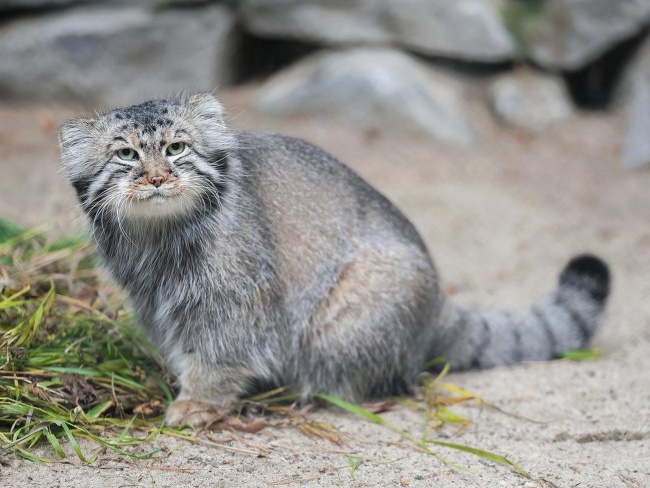
Pallas' cat is listed in the Red Book as a species close to extinction and all hunting of it is prohibited.
Judging by the expression on this wild cat's face, the last thing he wants is to be petted. Most likely, his facial expression (assuming cats have facial expressions) can be deciphered as, "Go where you're going!"
Life on his own
The manul is a very interesting cat. At someone's home you will not meet him, because this animal prefers to be wild and in the wildness of his stay until the end of the century. In any case, this is evidenced by those who had the opportunity to study the ancestors of Pallas' cat and come to the conclusion that these cats have existed for 12 million years and for such a long period of time and did not bother to change their way of life at least a little.
And why change it, you might ask? The Pallas's life is good enough as it is. He does not like to run, but likes to sit, lie down and sleep. Of course, from such interesting activities he sometimes has to be distracted by hunting mice and other rodents. But even related to hunting tedious movements manulu manages to do, almost without leaving the place. The thing is that its fur has such a camouflaging color that if the Pallas' cat will just sit (or lie down) and not move, the potential prey has no chance to notice it. Therefore, all passing by tasty and not ready for defense animals quickly become victims of the wild cat. If lucky, a gopher and even a hare fall on the table of a manul, but it should be a very unlucky hare, which would be better not to admire the beauties of nature, and every minute to think about its own survival. Dreamy hares and gophers who forget about this their main occupation in life, fall to the manul for lunch. The rest usually manage to escape.
Pallas' cat hunts at night or early morning, and during the day, like any good cat, prefers to sleep in someone's burrow or in the crevice of rocks. The territory, which he considers his own, is about 10 square kilometers. Any unauthorized cat will be immediately expelled by the owner beyond its limits. In March, the manul, like all cats, becomes "March", but after the rut quickly cools to family life, and the upbringing of kittens is engaged exclusively in the female.
Lucky German
As we have already said, many researchers tried to study the Pallas' cat, but not many succeeded. The discoverer of the mysterious beast is considered to be the naturalist Peter Simon Pallas ("a natural German who gave his life to Russia" - as it is said about him in the Russian Biographical Dictionary of Alexander Polovtsov). In the second half of the XVIII century, according to the order of Catherine II, who wanted to study his lands as closely as possible, Peter Pallas with an expedition went to the Caspian steppes, where he accidentally came across a Pallas's cat. Quickly realizing that none of his scientist friends had ever seen such cats before, neither in Prussia nor at the Russian royal court, Pallas tried to study his find in more detail. But the "find" looked at the naturalist unhappily, snorted something, waved its tail and disappeared among the rocks. All that the scientist had time to notice was unusually thick and long fur all over its body and a head with a disgruntled face and strange, very small ears for such an animal. Apparently resentful of the Pallas' manul for not wanting to be the object of study, Peter Pallas named his discovery Otocolobus, which translates as "ugly ear".
When the traveler told about the meeting with an extraordinary animal to his fellow scientists, they for some reason took him at his word and decided to call the previously unknown animal in honor of its discoverer Pallas's cat.
Except for Peter Pallas, nobody met the Pallas's cat until now. In any case, none of those people who would be interested in him as an object of study, not as the owner of a fur pelt.
The fluffiest in the world
Speaking of which, it is because of the unusually thick fur that the Pallas' cat seems to be a big cat. In fact, he is no larger than an ordinary domestic cat and weighs only two to six kilograms. But he can't do without a thick coat, because the Pallas' range is steppes, mountains and foothills of Central and Central Asia, Mongolia, Tibet and the north of China. And let you not be confused by the southern location of these countries. In fact, there are places where it is very cold, and it is in these places, for example, in the mountains at an altitude of up to four or five thousand meters, lives Pallas' cat. The density of his coat - up to nine thousand hairs per square centimeter (for comparison: the winter skin of the wolf density is slightly more than two thousand hairs per square centimeter), thanks to this increased fluffiness manul can feel quite comfortable at temperatures up to -50 °.
Why can not keep a Pallas' cat at home? First of all, it is against the law. This extremely rare cat is listed in the Red Book as a species close to extinction, and any hunting on it is prohibited. Secondly, it is practically not adapted to live and breed in captivity. In nature, Pallas' cats are so isolated that they are immune to most of the diseases that ordinary domestic cats can easily cope with. In short, in 90 percent of cases, a Pallas' cat will simply die in captivity from some elementary, in our opinion, disease. So this animal can be kept only in zoos and under constant supervision of a veterinarian. In the early 1990s, the Pallas' cat could be seen only in 13 zoos around the world.
On the verge of extinction
Unfortunately, these unique cats are approaching the threshold of their extinction, even though poachers do not hunt them on purpose - it is too expensive and unprofitable. However, although rarely, Pallas' cats are caught in traps and snares designed for other animals. In recent decades, there are almost no Pallas' cats left in the steppes, but those who are hiding in the mountains cannot boast of high numbers. According to rough estimates, there are 200-300 of them left in Altai Krai; in Buryatia - 50-70. That is, the maximum density of animals in some habitats is no more than three heads per 10 square kilometers. But these figures were obtained more than a quarter of a century ago. No one can say how many of these cats are preserved in the wild now.
Brief characteristics
Class: mammals.
Habitats: Central and Central Asia, Tibet, Mongolia, northern China.
Food: predators.
Life span: up to 12 years.
Body length: up to 65 centimeters.
Interesting facts
Interestingly, Pallas' cats differ from ordinary domestic cats in their eyes.
The pupils of an ordinary cat dilate and constrict depending on the light.
Pallas' pupils always remain the same size.