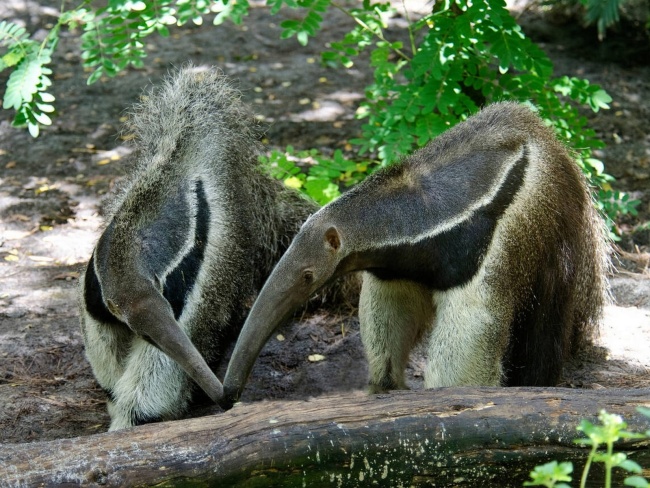
The giant anteater is listed in the International Union for Conservation of Nature and Natural Resources Red List.
The giant anteater (Myrmecophaga tridactyla), along with its closest relatives the tamandua and pygmy anteater, are members of the order of incomplete-toothed mammals. This animal with a long muzzle, fluffy tail and no neck is in many ways very unusual.
PEACEFUL, BUT VERY BRAVE
Anteaters outside of mating season live separately. They sleep up to 15 hours a day. Free time these peace-loving animals spend searching for food, roaming the savannah. Anteaters have excellent hearing, which allows them to spot enemies in time. In case of danger, they run away sometimes even into the water, since they swim well. If the giant anteater put in a desperate situation, he uses a very effective defense technique: stepping on the enemy, such as a puma or a jaguar, straightens the upper part of the body, and uses the tail as a support, and strikes with front paws with sharp claws up to 10 cm long. In doing so, the giant anteater often wraps its claws around its opponent and tears his back, leaving deep wounds.
SUPERBLY BUILT FOR ITS FAVORITE MEAL.
The giant anteater's menu includes grubs, worms and soft fruits. But most eagerly he eats ants and termites, which he searches for with the help of a well-developed sense of smell. After reaching an anthill or termite building, it opens up the colony with its front paws with sickle-shaped claws. He then dips his long, sticky tongue into their passages. Up to 160 times a minute, it retracts its tongue into its mouth. The prey is scraped against the horny tubercles in its long, slightly curved mouth and sent to its stomach, where the food is processed. In a short time it licks up several hundred ants and then travels onward. In this way, the ant colony is not completely destroyed and may soon visit again.
For protection against bites, the giant anteater has a very thick and stiff hair. In addition, by acting its thick, fluffy tail like a broom, it can free itself from its little tormentors.
WHY RUN WHEN YOU'RE BEING CARRIED?
Female giant anteaters can mate twice a year. When it comes to fertilization, depending on the time of year, the female may delay the introduction of the embryo into the uterus. This way, the young animals are born at a favorable time. Pregnancy lasts about 190 days.
As a rule, one cub is born, which is fully developed and can immediately run. But instead, the baby immediately climbs on the mother's back and allows itself to be carried everywhere for about nine months.
INTERESTING FACTS
Anteater's tongue
An anteater can stick out its tongue, which is about 1 meter long, no more than 60 cm from its mouth. The tongue is like a worm - thin and extremely mobile. In addition, it is covered with sticky saliva, in which the prey is stuck and carried further into the mouth. For this purpose, the giant anteater produces a large amount of saliva like no other animal in the world. The tongue never dries out.
BRIEF DESCRIPTION
Giant anteater (Myrmecophaga tridactyla)
Class mammals.
Division Incomplete-toothed.
Family Anteaters.
Distribution: South and Central America.
Length of body with head: 100-130 cm.
Weight: 30-35 kg.
Food: mainly ants and termites.
Sexual maturity: not known.
Duration of gestation: 180-190 days. Number of cubs: 1.
Life expectancy: 26 years (in captivity and reserves).