
Scientific Classification
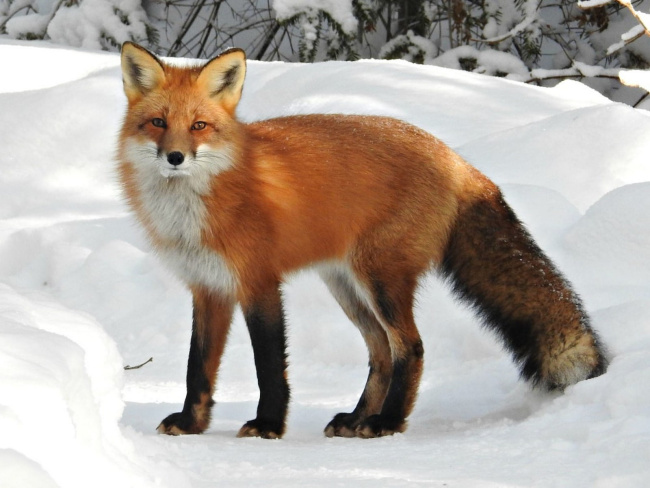
This beautiful predator with an elongated narrow muzzle, pointed ears and a long fluffy tail inhabits the whole of Eurasia. The fox is found almost everywhere: in the southern tundra, forests, steppes, deserts and mountains.
It is one of the most widespread and well-known predatory animals of Russia.
It is not by chance that so many fairy tales have been written about the red-haired rascal. However, how much do we know about the real life of the fox?
Where does it live? What does it eat? How does she arrange her family life? And, finally, is she really so cunning?
Perhaps the first thing that has always attracted people to the fox is its magnificent fur. From spring to mid-summer the animal molts, but by autumn its coat becomes simply magnificent: soft, thick, rich in color. The harsher the climate, the more beautiful the fur. In the southern latitudes foxes are yellowish-gray, there are even quite white, albino. In the middle belt of Russia - red, in Siberia and the Far East - red-orange, brown, black-brown.
Hunters are sure: the smoother the animal's trail, the better its coat. The trail of a fox is unusual: it so carefully puts its hind paws in the traces of its front paws that it turns out to be almost nail to nail. The fox always follows the same trail to the same place, especially if the snow is very deep.
Daily mode and ration
Although foxes are quite common even in suburban forests, it is difficult to see them during the day. The animal sleeps at this time, hiding in bushes, ravines or dense grass. Active life begins at dusk - the fox goes out to hunt. For this purpose it chooses the edge of the forest, meadow, field or river bank.
The composition of the animal's food is unusually diverse: hamsters and gophers, various birds and their eggs, fish, lizards, frogs, snakes and snails, beetles, wasps and bees, honey, berries and fruits.... It should be noted that hares together with birds occupy only 5-10% of the fox's food. Its main food is mice and voles. They make up 80-90% of the animal's diet.
Hard to believe
A fox's diet includes about 400 species of animals and several dozen species of plants. The fox is strong enough to strangle a baby spotted deer, it can easily handle roe deer cubs and even adult animals on the ground.
The fox is mousing: he is on duty near small holes, hardly visible in the grass or snow, looking closely, listening to the squeaks, catching a convenient moment to rush to the mouse, chasing it in all directions. It seems that the fox likes this activity very much, because even when it is full, it continues to play.
Fox hole
The fox may dig its own burrow, but more often it occupies the dwellings of badgers, foxes, marmots and even porcupines. Less often it makes a nest in rock crevices and hollows of large trees, but necessarily in dry and secluded places. In addition to the chamber in which the fox family lives, there are several additional holes in the burrow. They serve for ventilation of the burrow, but most importantly - these are escape routes in case of danger. In winter, foxes use temporary burrows in snow and bushes (fleas and ticks leave the burrow in the absence of their hosts).
The female finds a suitable brooding site, marks and guards it, and at the end of winter the male joins her. Now they visit the nesting site together more often and remodel the burrow to their liking. The female is often courted by two or three males, and there are bloody fights between them.
Family life
Pregnancy in foxes lasts 49-58 days. The female goes hunting less and less often, and her partner has to get twice as much food. When foxes are born, and there are from 4 to 13 of them, there is more worry.
Foxes are born blind. Only on the 10th-12th day they start to see and their first teeth erupt. At this age they are very similar to the cubs of a dog, and they are also called puppies. The mother feeds the cubs milk for about three months and then begins to accustom them to adult food. When coming to a burrow with a wort or a bird, the fox calls the cubs with a snort. Once out of the burrow, the hungry fox cubs start a fight. They snatch their prey from each other, gnaw, scratch with their front paws or, clutching each other, roll on the ground in a ball. Most of the food goes to the strongest. In the meantime, the fox runs away for a new portion.
If, after returning from hunting, one of the parents finds that people have been near the burrow, the fox family immediately goes to an alternate burrow or a secluded place.
After waiting a few days, the foxes return. Besides humans, foxes have other enemies. They are attacked by owls, goshawks, crows, and even stray dogs pose a danger to the babies. By fall, the foxes grow up and can live independently. The family breaks up. Everyone leaves in search of their own plot and a new pair.
Each fox inhabits an area of 30 to 100 square kilometers. During a winter day, a fox runs 10-30 km.
CHARACTER
The fox's cunning and cleverness are not invented by the people. In hungry years, this red-haired robber steals chickens and ducks in the village at night and can even chew up a goat.
The fox behaves like a real artist when catching grouse gathered in the open meadow.
It pretends as if it is full and tired and is not interested in birds. It walks around slowly, does not even look in their direction, lies down, takes a nap, and then moves a meter or two to them. The performance can last more than an hour. When the birds completely lose their vigilance, the huntress makes several powerful jumps.
Living near rivers, foxes feed on salmon fish.
They often catch colts, raccoon dogs, he dates and other animals, which also requires observation and ingenuity.
It was the cunning and cunningness of foxes that made this “red beast” a favorite object of dog hunting, which flourished in Russia in the XVIII-XIX centuries. Only a fox is capable of doing such a thing, as it can hopelessly confuse the trail, lead a pack of hounds into impassable wilds and drowns, and then escape from death by lurking in a burrow or even by plunging into water! And in a desperate situation, the red-haired rascal pretends to be dead in the hope that the enemy will lose interest in her.
In hungry years, this red-haired robber cleverly steals chickens and ducks in the village at night, can
. But stories that the fox cunningly survives from the burrow of the badger, do not correspond to reality. The fox family sometimes settles in a residential badger burrow, but occupies a remote den and tries to avoid conflicts with the legal owner. "The foxes pay for their stay with the remains of their meals, which the badger eagerly eats.