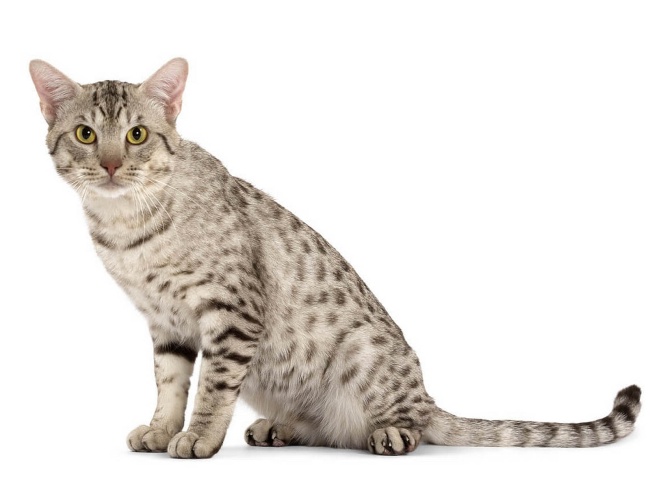
Ocicats resemble wild cats in exterior, but are not related to them in any way. No hybridization work was carried out, only interbreeding took place.
The result was a cat with a "wild" appearance and a completely domestic character.Otsiket loves water, calmly allows himself to bathe.
He is very friendly and affectionate, does not tolerate loneliness.
History of the breed
In 1964, felinologist Virginia Daly from Michigan crossed Siamese and Abyssinian cats in an attempt to get an unusual-looking individual. She envisioned that the animals would be a combination of pointe and ticking colors.However, the first kitten was born spotted and looked like a wild ocelot.The unexpected result so impressed the breeder that she continued breeding these cats. Crossbreeding of Ocicutes with Siamese cats was stopped in 1986, with Abyssinian cats - in 2005. In 1987 the breed was officially recognized.
Ocicutes are highly social creatures. They will never sit in the far room under the sofa if you have guests over.
Care
Beautiful short hair of animals does not need special care. It is enough to comb it out a few times a month and wash it during the shedding period. Regular claw clipping, a balanced diet and frequent communication with the owner are the basic rules for caring for an otsiket.
Ocicats are very sociable cats, their behavior is more like a dog's than a cat's. They are easy to train, allow themselves to be led on a leash, respond to the name and perform other "dog" tricks.
Breeding
The following colors are allowed by the standard: brown, chocolate, purple, blue, cinnamon and fawn. Defects of the breed are considered to be too massive body, indistinct spots, as well as any amount of white color on the coat. Interbreeding is prohibited by the standard.