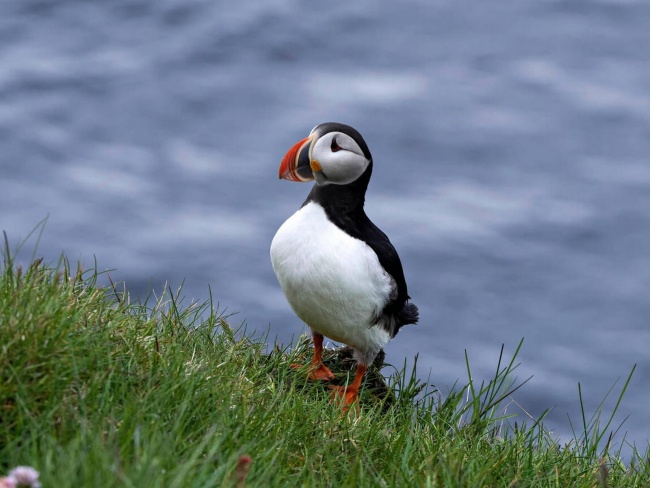
Due to the peculiar structure of its beak, the deadbeak can hold many small fish at the same time.
Tupiks are distinguished by their amazing beak structure. In shape and color, the beak of the tupik is similar to that of a parrot: it is planted high and can be colored blue, yellow or red. It was probably at first more important during pair formation and during the current than when hunting its victims. The scientific name of the bird Fratercula arctica means "northern brother" in Latin and is related to the fact that during flight these birds fold their wings like monks fold their hands during prayer.
"MOLE" AT THE BIRD MARKET
Unlike many other loons - birds nesting on rocky cliffs, tupiks prefer grassy slopes where they dig burrows up to several meters deep with their leaf-shaped beaks for nesting. Sometimes they nest in burrows of rabbits or petrels, or even just under rocks. It happens that several pairs of tupiks use the same entrance, which then leads to different nesting chambers. Once formed, pairs of deadbeats usually stay together for many years during the nesting period. The care of the chicks is shared by both partners.
The chicks spend at least five weeks in the nest. But this period can be doubled if food is scarce.
THE FISH IN THE BEAK OF A DEADBEAK IS STACKED IN ROWS.
In pursuit of prey, tupiks can dive to a depth of 15 m and stay underwater for up to 1 min. The birds prefer to catch sandflies, sprats, capelin, herring, and in winter time - crustaceans and mollusks. They carry the caught fish to the surface, holding it across the beak, clamping between the upper part of the beak and the tongue up to 60 fish at a time and stacking them in rows.
TUCHES OF BIRDS
The population of tupicbirds is estimated at about 6 million pairs. They are one of the most common birds in the North Atlantic. They settle in huge colonies on gentle coasts from West Greenland to the northeastern coasts of the United States and Svalbard, and further habitats include Novaya Zemlya, the Kola Peninsula, Norway, Iceland, the British Isles, and as far as Brittany (in France). The largest colonies inhabit Iceland, the Faroe Islands, as well as Scotland and Norway. In winter, deadflies disperse to sea, flying far from their home nests; they can be found in various places in the North Atlantic between 50 and 80 degrees north latitude, on the margins of the continent, as well as much farther south, west of New Jersey, and eastward to the western parts of the Mediterranean Sea and the Canary Islands.
Up until 1960, the population of tupiks was declining throughout the North Atlantic, but then the situation stabilized markedly, and their numbers even increased in some regions.
PACIFIC RELATIVE
In the North Pacific Ocean, from Alaska through the Aleutian Islands and up to Sakhalin and the Kurils, there is a relative of the Atlantic Tupic, the Pacific Tupic, or pipit (Fratercula corniculata). This bird differs only by a horny outgrowth above the eyes and a bright yellow base of the beak. Like the Atlantic tupic, the pipit nests on inaccessible steep slopes. There are only about 600,000 pairs of them left.
BRIEF DESCRIPTION
Tupic (Fratercula arctica)
Class of birds.
Order plovers.
Family Pipistrelidae.
Distribution: coasts of the North Atlantic and islands of the Arctic Ocean.
Length: up to 26-30 cm.
Wingspan: 60 cm.
Weight: 500 g.
Food: small fish (sandfishes, herring), as well as crustaceans and mollusks.
Sexual maturity: 5-6 years.
Number of eggs: 1.
Duration of incubation: 35-36 days.
Life span: over 20 years.