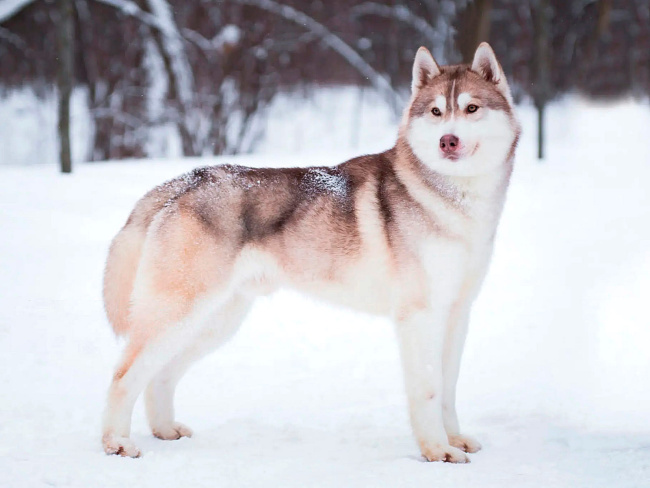
Huskies like to hunt, but they do it inefficiently: they catch prey, but do not bring it - they like the process itself.
Dog sledding is the traditional means of transportation of the peoples of the North. Once it was the only way to get to the necessary place through snow drifts, and all thanks to fast and hardy sled dogs - Arctic Huskies. And though representatives of this breed have long ago settled in city apartments as pets, they have not lost their working qualities.
Many geographical discoveries would hardly have taken place without these sled dogs with thick fur, standing ears and fluffy tails. Four-legged friends helped brave people to conquer the poles of the Earth. After all, in the harsh North, to lose the ability to move quickly is tantamount to death. In many areas of the Far North, brave huskies were the only pets accompanying people.
Indispensable dogs
As sled dogs Siberian Huskies are valued for their ability to move quickly in open spaces, unpretentiousness to conditions, ability to recognize danger, carry heavy loads and clearly follow commands.
Temperament and Character
Huskies are very friendly dogs. They are happy to get to know other animals and people. For their family, they are loyal and reliable friends who are always happy to socialize and love to be the center of attention. They are not vindictive and very curious.
Representatives of this breed are born travelers. They are interested in learning new things, so they can easily part with their owner for a short time to follow an interesting thing or explore an unknown territory.
Intelligent huskies are easy to train. Raising these dogs is a pleasure. The main thing is to be persistent and moderately strict, so that the easy-going pet can distinguish learning from play.
A husky's howl is said to be most similar to that of a wolf.
History of the breed
This fact is not widely known, but dogs were domesticated in the North much earlier than reindeer. These faithful friends of man accompanied him even in the harshest conditions.
In 1742, it was on a dog sled that the Russian traveler Semyon Ivanovich Chelyuskin first reached the north of Asia's present-day Cape Chelyuskin. Many kilometers were traveled with the help of sled dogs by Khariton Laptev, Nikifor Chekin and other explorers.
Representatives of this breed were first brought from Siberia to the USA in 1908. Here they were immediately appreciated due to their excellent racing qualities. In the USSR, sled dogs fell out of the general register of northern breeds and were recognized as unpromising. But in 1934 Arctic Huskies were recognized in the USA and set the breed standard. Until now they are considered to be the fastest and most enduring among Alaskan sled dogs.
Siberian Huskies returned to Russia only after the collapse of the USSR. The first official kennel of dogs of this breed appeared in 1995.
By the way
The real popularity came to huskies in 1925 after the story of Leonard Sappala's sled that delivered a diphtheria vaccine to the city of Nome.
Care and upbringing
This breed is very clean. Their coat and skin are odorless and do not need special care. It is enough to comb the pet during shedding twice a year. It is not necessary to shear the coat at all.
It is also important for husky owners to remember to exercise their pet regularly. Without proper exercise, the dog becomes bored and mischievous. In addition, it can go off on its own to travel at the first opportunity.
Having appeared in the family, the husky will claim leadership. From the very first days it is desirable to show the pet who is in charge in the house.