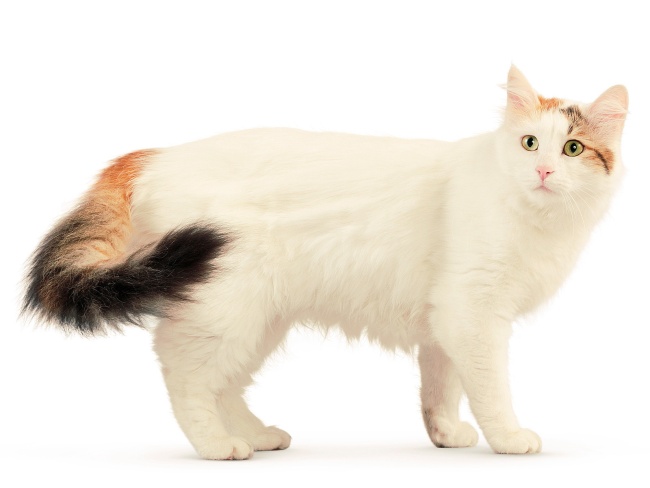
The Turkish Van is a very beautiful large cat. Van follows his owner everywhere, wondering what he is doing.
The cat is not too fond of sitting on hands, but otherwise it is an affectionate, docile and intelligent animal, which is a pleasure to communicate with.
History of the breed
This is an indigenous breed, its homeland is considered to be the neighborhood of Lake Van. The Turkish Van is believed to be the oldest of the cats, which lived before the Flood. The modern history of this breed began in the 1960s, when several kittens were brought from Turkey to the United States. The babies charmed everyone not only by their appearance, but also by the fact that they were not frightened at the sight of a body of water, but frolicked merrily in the water. Officially, the breed, called the Turkish Van cat, was registered in 1969.
There is an opinion that the first Van cats together with Angoras were brought by crusaders as trophies, but since all white long-haired cats, regardless of the presence of spots, were called Angoras in those times, it is impossible to check this information.
Care
The luxurious coat of the Van needs daily combing and occasional washing. These waterfowl cats have excellent health, excellent immunity. With proper care, they have every chance to become long-lived.
Breeding
When crossing two purebred Van cats, a litter with a characteristic Van color will be obtained. If the offspring does not have it, it means that the individuals for mating were not purebred. Currently, some standards allow for different colors, but the classic is considered to be the Van color. Defects of the breed: deafness (characteristic for pure white Van), tail splits and curvature of the jaw.