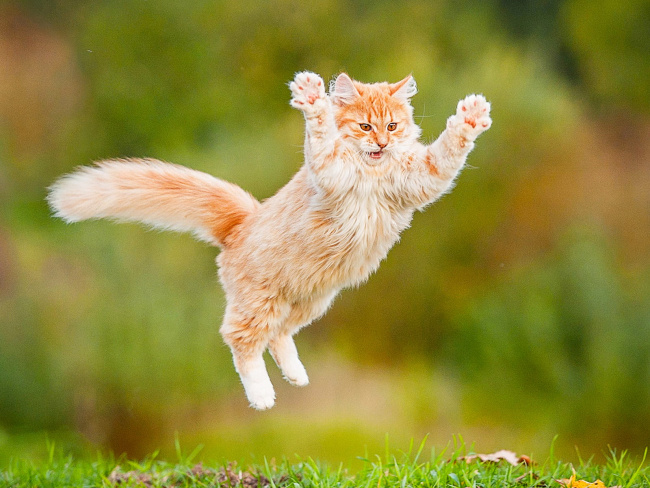
In this respect, cats and humans are in stark contrast. Cats are completely indifferent to heights. It's not that they rarely fall. On the contrary, cats very often fall from high cornices and balconies because they play and chase each other fearlessly at heights. Veterinarians are so often brought cats that have fallen that a special term has appeared in their vocabulary: “high-altitude syndrome in cats.”
Paradoxically, the higher the building, the less likely a cat is to die. The ability to withstand such terrible falls is the main fact on which the belief that cats have nine lives is based.
Uncovering the secrets of cats' resilience could help us reduce high-altitude injuries. Studying statistics on cat falls allows us to gain knowledge where targeted experiments would be highly controversial. This is because the injuries sustained by cats are very different from those sustained by humans. Humans most often die from head injuries and internal bleeding. This is followed by broken spines and rib cages. In cats, the most common injury was bleeding from the nose. Cats also suffered lacerations to the muzzle, broken teeth, broken palates and lower jaws, and chest wounds.
Strangely enough, cats' chances of survival increase with height: only 5% died after falling from the 7th to 15th floors, while twice as many — 10% — died after falling from the 2nd to 6th floors. You would hardly ask a person threatening to throw you from the 2nd floor to choose the 15th floor instead to ease your fate! Another advantage of cats, besides their light weight, is that they can bend their limbs to distribute the force of the impact across their joints and muscles. Since we are deprived of a sensitive “gyroscope,” it would be useful to learn from cats how to bend our legs to soften the blow when falling.
By the way
Despite cats' predisposition to falling, there are far fewer fatalities than in humans. And it's not just because cats, unlike humans, can survive a fall from a six-story building. More striking is the fact that cats survive in most cases after diving onto asphalt from skyscrapers. Apparently, the record holder (at least in New York) is a kitten named Sabrina, who fell onto the sidewalk from the 32nd floor and suffered minor injuries: she had a tooth knocked out and a slight wound to her chest.
However, even this advantage of cats does not explain the most surprising fact — their increased chances of survival when falling from a height greater than the 7th floor. Remember that bodies falling in the Earth's atmosphere accelerate to a certain maximum speed, the value of which depends on air resistance and weight. After that, their speed remains constant — until their weight and surface area change. Weight, of course, cannot change, but the area exposed to the air flow can be changed. Parachutists in free fall reduce the area and increase the speed of fall by stretching out straight, and by spreading their arms and legs to the sides, they increase the area and reduce the speed.
In short, falling cats are in many ways much less at risk than humans. Their low weight means less impact force, less pressure (force divided by area), and lower terminal velocity. All these qualities are also found in other small animals, but cats still take fewer risks than small dogs. This is explained by their additional advantages: among them are an excellent “gyroscope” that allows cats to fall feet first rather than head first, and flexible limbs that distribute the load across joints and muscles. and finally, their ability to assume a flying squirrel-like posture after reaching maximum speed.
Knowledge from the field of evolutionary biology suggests that cats' unique abilities developed through natural selection. Most species of the cat family climb trees, while only a few species of dogs do so. For millions of years, cats have been jumping on their prey from trees.
Real skydivers
It is quite possible that cats can do the same thing as trained skydivers. Before reaching their maximum speed, they instinctively stretch out their limbs, which can then break on impact.
Once maximum speed is reached, cats begin to feel the accelerating force of gravity and can relax, spreading their paws horizontally like a flying squirrel. This increases air resistance, which is distributed over the entire body surface, and reduces speed.